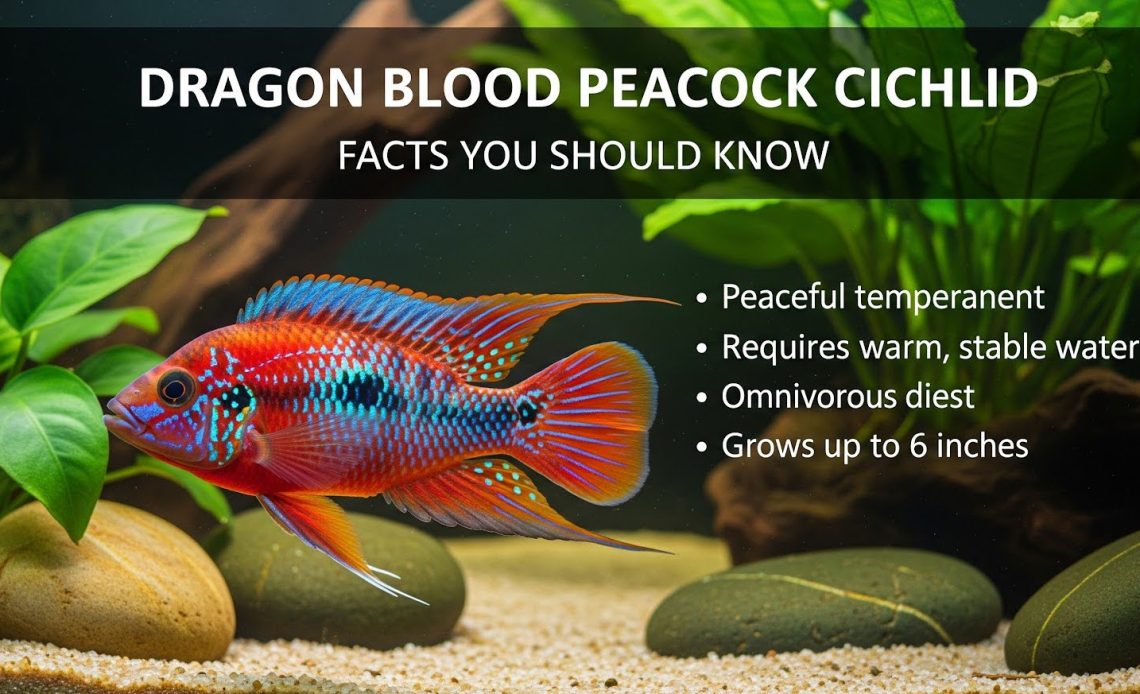
The Dragon Blood Peacock Cichlid is one of the most stunning freshwater fishes in the aquarium world. Due to its orange, pink, and red color, this hybrid cichlid is the center of attraction of any aquarium as soon as it’s placed there. Its calm swimming, odd behavior, and easy-to-care-for nature make it no surprise that aquarists from all over the world love and maintain them.
Here we explore in-depth all you need to know about the Dragon Blood Peacock Cichlid — from its origin and color to tank setup, diet, breeding, and compatibility. Whether you are an experienced fish keeper or just starting out, this article will help you feed your fish but still keep them happy, healthy, and colorful.
What is a Dragon Blood Peacock Cichlid?
Dragon Blood Peacock Cichlid is not found in the wild. They are selectively hybridized fish and part of the Aulonocara family of fish or peacock cichlids. The colorless and duller version of the already colorful peacock cichlids native to Lake Malawi in Africa necessitated the development of these hybrids by the breeders.
- Scientific classification: Aulonocara hybrid
- Common names for this cichlid are dragons blood peacock, dragons blood cichlid, blood dragon peacock, dragon blood aulonocara cichlid.
- Parent origin: Lake Malawi, Africa
- Development method: Systematic cross-breeding amongst different Aulonocara species
The breeding process enhances the natural color of the fish, producing lovely shades and markings not usually found in wild stock. This is also why their colors are so regular and bright compared to their wild offspring.
What Colors Do Dragon Blood Peacock Cichlids Come In?
One of the most thrilling aspects of the dragon blood peacock fish is the variety of colors. Although red is the iconic color, there are several variations bred by breeders.
Popular color varieties include:
- Deep Red: Rich, uniform red, nose to tail, most commonly found in fully mature males.
- Orange-Red: Mix of hot orange and red colors, with warm appearance.
- Pink-Red: Pale types, occasionally with blinding highlights.
- Marbled Patterns: Stripes or splashes of light color over a red base.
They can change the color intensity depending on diet, mood, water quality, and age. The younger fish will be less colored, with the colors increasing as the fish age.
Best Tank Size for Dragon Blood Peacock Cichlids
Dragon Blood Peacock Cichlids are active swimmers that require room to roam and develop territories.
- For a single fish: 55 gallons minimum
- For a group: 75–90 gallons or larger
- Reason: Large tanks minimize aggression and stress and provide improved water stability.
A large tank also allows for easier creation of territories with rocks, caves, and open swimming spaces.
Tank Setup for Dragon Blood Peacock Cichlids
To simulate their natural environment and maintain them in health, pursue a setup that is close to the rocky lakeshores of Lake Malawi.
Key elements:
- Substrate: Sand or fine gravel (gentle on their fins)
- Rocks and Caves: Offer hiding places and territorial borders
- Lighting: Medium, to enhance color without stressing the fish
- Filtration: Strong and efficient, as cichlids produce abundant waste
- Aquascaping tip: Create open swimming area in the center and hideaways in the sides
Steer clear of sharp ornaments that may injure their fins, and make sure that any rocks are firmly positioned to avoid collapse.
Are Dragon Blood Peacock Cichlids Aggressive?
The peacock cichlid, dragon blood is classed as semi-aggressive. Though in general more relaxed than a lot of other African cichlids, males can be territorial when it comes to breeding.
Tips for controlling aggression:
- Maintain a ratio of 1 male to 3–4 females.
- Do not keep multiple males in small tanks.
- Occasionally rearrange tank decor to break up territorial lines.
- Offer multiple areas to hide to alleviate stress.
Can Dragon Blood Peacock Cichlids be Kept with Other Cichlids?
Yes, but select tank mates carefully.
Good tank mates are:
- Other peacock cichlid species
- Haplochromis species of similar temperament
- Some peaceful Mbuna varieties
- Synodontis catfish
Avoid:
- Extremely aggressive African cichlids
- Small fish that can be confused for food
What Do Dragon Blood Peacock Cichlids Eat?
Peacock cichlids in the wild consume small invertebrates, insects, and crustaceans. The dragon blood peacock thrives on a varied diet under aquaculture.
Recommended diet:
- High-quality cichlid pellets
- Frozen or live brine shrimp
- Bloodworms
- Spirulina-based flakes for additional nutrients
Feeding tips:
- Feed 1–2 times a day
- Provide only as much food as they can consume in 2–3 minutes
- Remove any unused food to avoid water contamination
How Large Do Dragon Blood Peacock Cichlids Get?
Males will reach 5–6 inches and females 4–5 inches. Good diet and large tank allow them to grow to full size.
Ideal Water Parameters for Dragon Blood Peacock Cichlids
Being Lake Malawi fish descendants, dragon blood aulonocara cichlids do best in hard, alkaline water.
Optimal conditions:
- Temperature: 76–82°F (24–28°C)
- pH: 7.8–8.6
- Hardness: 8–12 dGH
- Filtration: Active biological and mechanical filtration
How to Tell if a Dragon Blood Peacock is Male or Female
Males:
- Brighter orange or red color
- Larger in size
- Longer, pointed dorsal and anal fins
Females:
- Paler colors
- Smaller in size
- Rounder fins
Do Dragon Blood Peacock Cichlids Change Color with Time?
Yes, the intensity of their colors depends on age, mood, and environment. Their colors deepen with age for males, whereas stress or adverse conditions render them pale.
Breeding Dragon Blood Peacock Cichlids
These fish are so interesting to breed since they are mouthbrooders.
Steps to breed:
- Place 1 male with 3–4 females in a breeding tank.
- Offer flat rocks for spawning.
- The female stores eggs after spawning in her mouth for around 21–28 days.
- Once the fry are released, transfer them to a rearing tank.
The fry can be fed crushed baby pellets or baby brine shrimp until they can accommodate the main tank.
Care Challenges and Tips
Hardy as it may be, the blood dragon peacock still requires proper care.
Common challenges:
- Aggression among males
- Fading color from poor diet or water quality
- Overcrowding causing stress
Pro tips:
- Keep clean water with frequent changes (25–30% weekly)
- Provide a balanced, color-inducing diet
- Watch for disease and treat immediately
Quick Care Overview
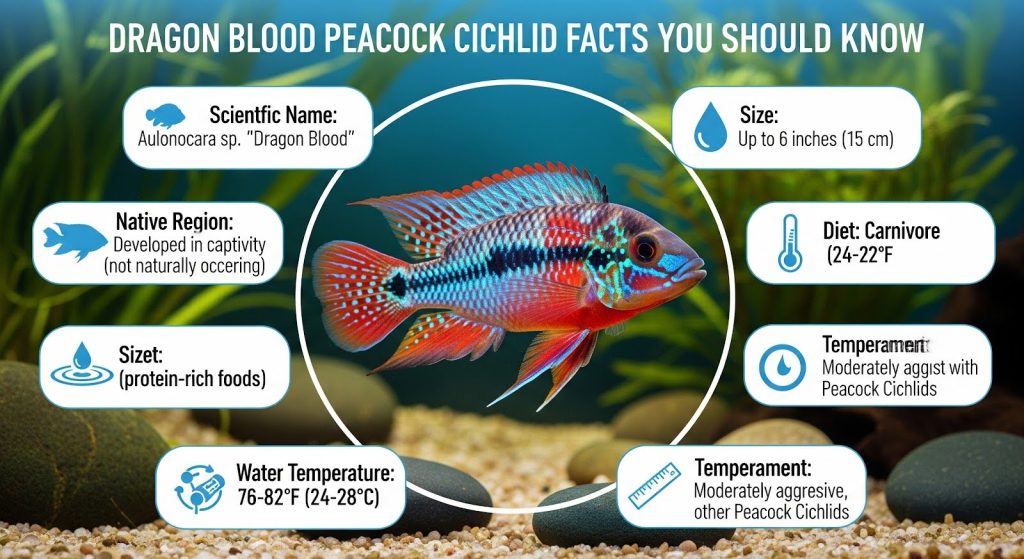
- Scientific name: Aulonocara hybrid
- Size: 4–6 inches
- Diet: Omnivore, insectivore preference
- Temperament: Semi-aggressive
- Tank size: 55+ gallons
- Water pH: 7.8–8.6
- Temperature: 76–82°F
- Lifespan: 6–10 years
Conclusion
With the correct tank, food, and water conditions, the Dragon Blood Peacock Cichlid adds drama to any freshwater aquarium. It is also colorful, fascinating, and aesthetically pleasing to keep. Bright colors, fascinating habits, and many years of witnessing the growth of these energetic cichlids are all within your reach with a little preparation.
Males can be territorial, so to reduce stress and help them display their best colors, give them room and suitable tank mates.
FAQs
What is a Dragon Blood Peacock Cichlid, and how was it created?
It is a selectively bred hybrid of the Aulonocara peacock cichlid genus. Breeder cross-bred various species to produce the bright red and orange coloration that does not occur naturally.
How large a tank should Dragon Blood Peacock Cichlids have?
An individual will require at least 55 gallons, but a small community will be more at ease in a 75–90 gallon tank.
Are Dragon Blood Peacock Cichlids aggressive?
They are moderately aggressive. Males will become territorial, particularly at breeding, so give them sufficient space and covers.
Can Dragon Blood Peacock Cichlids cohabit with other cichlids?
Yes, peaceful African cichlids of the same size, such as other peacocks, haps, or specific mbuna species, can be kept with them.
What does a Dragon Blood Peacock Cichlid eat?
A well-balanced diet of top-quality cichlid pellets, brine shrimp, spirulina flakes, and occasional bloodworms for treats is best.
How large do Dragon Blood Peacock Cichlids become?
Males typically reach 5–6 inches, while females are around 4–5 inches.
What are the optimal water parameters for Dragon Blood Peacock Cichlids?
They perform well in 76–82°F water with a pH of 7.8–8.6 and hardness of 8–12 dGH.
How do I know whether my Dragon Blood Peacock is male or female?
Males are more colorful, larger, and more extended fins, and females are smaller and paler in color.
Do Dragon Blood Peacock Cichlids change color as they mature?
Yes, their colors tend to become more vibrant with age, particularly in males. Stress or poor water conditions can cause their colors to pale.
How frequently should I feed Dragon Blood Peacock Cichlids?
Feed them once or twice a day with quantities they can devour within 2–3 minutes.
References:
Quantitative Genetic Analyses of Male Color Pattern and Female Mate Choice in Lake Malawi Cichlids
https://www.ncbi.nlm.nih.gov/pmc/articles/PMC4262453
Oxford Academic / Journal of Heredity, Introgressive Hybridization Between Color Morphs in a Population of Cichlid Fishes
https://academic.oup.com/jhered/article/103/4/515/1025433
Distinct Genetic Origins of Eumelanin Levels and Barring Patterns in Cichlid Fishes
https://www.ncbi.nlm.nih.gov/pmc/articles/PMC11230561
Selection and Breeding Programs in Aquaculture
https://link.springer.com/book/10.1007/1-4020-3342-7
Aulonocara jacobfreibergi, Species Summary
https://www.fishbase.se/summary/SpeciesSummary.php?genusname=Aulonocara&speciesname=jacobfreibergi
