Slow fish growth is a problem for many aquarists. According to market research, 31 percent of aquarium hobbyists report that fish experience health problems (poor growth, coloration) due to improper diet or water pollutants.
You care about your tank. You want vibrant color and steady development. Yet your Aulonocara walteri growth tips searches often feel generic. Advice lacks precision.
This leads to dull fish. Growth plateaus frustrate you. Your peacock cichlid care routine might feel incomplete.
This guide solves that. You will learn actionable steps to quickly improve size, coloration, and vitality.
What Are the Best Aulonocara walteri Growth Tips?
The most effective method to enhance growth is through diet, water stability, and tank ecology optimization. Stability is more important than high-cost equipment.
The fish tank requires balanced feeding, and growth is dependent on the water parameters. The Walteri peacock lives in stable environments.
Key Growth Drivers
| Factor | Impact Level | Action Required |
| Protein intake | High | Use a varied diet |
| Water quality | Critical | Weekly testing |
| Tank space | Medium | Avoid crowding |
| Stress levels | High | Limit aggression |
Focus on these pillars. You will see measurable improvement within weeks.
What Are the Proven Aulonocara walteri Growth Tips?
The fastest path to growth combines three pillars: optimized nutrition, stable water, and stress-free territory management.
Nutrition Optimization
The three pillars of the fastest way to grow are the best nutrition, stable water, and stress-free territory management. Include:
- Frozen bloodworms or brine shrimp to give a high-protein burst.
- Spirulina or microalgae to increase color and health.
- Rotational feeding to simulate natural Lake Malawi foraging.
Tip: Small portions should be fed 2-3 times per day to enhance growth and digestion.
Water Parameters Matter More Than You Think
Even minor fluctuations in pH, temperature, and hardness inhibit growth. Optimal aquarium conditions of Walteri peacock cichlids:
| Parameter | Ideal Range |
| pH | 7.5–8.5 |
| Temperature | 24–27°C |
| Hardness | Moderate |
Routine partial water replacement, substrate cleaning, and monitoring of ammonia/nitrite keep the ecosystem stable. Research indicates that stable water is directly related to efficient feeding and higher growth (ScienceDirect, 2022).
Stress-Free Tank Setup
Aggression is a silent growth killer. The Blue-Faced Walteri requires a structured territory to avoid conflict.
- Sand substrate for natural digging behavior
- Rock caves for hiding and reduced stress
- Open swimming space for juvenile growth
Do not keep Mbuna or highly territorial species, which inhibit feeding effectiveness and size growth.
How to Feed Aulonocara walteri for Faster Growth?
Feed high-protein meals twice a day. Do not overfeed, as waste damages water quality.
The aulonocara peacock cichlid needs a mixed diet. These consist of insect-based pellets and frozen foods.
Recommended Diet Plan
- High-protein pellets in the morning
- Frozen brine shrimp or bloodworms in the evening
- Weekly Spirulina supplement
This mimics natural feeding behavior. It boosts fish health and coloration while accelerating growth.
What Tank Conditions Maximize Growth Rate?
Stable water parameters are essential. Sudden fluctuations stunt development quickly.
Ensure good filtration and oxygenation. The aquarium maintenance routine must remain consistent.
Ideal Water Parameters
| Parameter | Ideal Range |
| pH | 7.5–8.5 |
| Temp | 24–27°C |
| Hardness | Moderate |
These conditions replicate Lake Malawi. The Aulonocara walteri adapts best here.
Why Is Your Walteri Peacock Not Growing Properly?
Poor growth usually stems from stress or diet imbalance. Overcrowding worsens the issue.
The Walteri peacock cichlid needs space and calm surroundings. Aggressive tank mates hinder development.
Common Mistakes
- Overfeeding low-quality food
- Mixing with aggressive Mbuna
- Ignoring water testing
Avoid these errors. Growth improves rapidly when corrected.
What Role Does Tank Setup Play in Growth?
Tank design influences stress levels. Stress directly impacts growth speed.
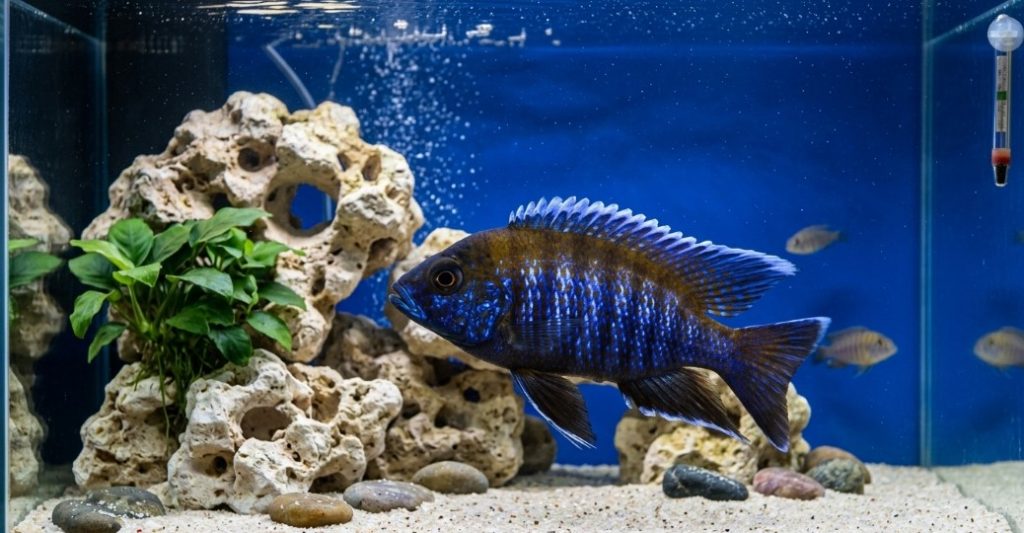
Use sand substrate with rock structures. This suits the Walteri cichlid environment.
Ideal Setup Elements
- Open swimming space
- Rock caves for hiding
- Minimal plants
This layout supports natural behavior. It enhances cichlid tank setup efficiency.
How to Improve Color and Size Together?
Color and growth depend on diet and genetics. Proper care enhances both simultaneously.
Feed carotenoid-rich foods. Maintain stable lighting cycles.
The Blue Face Peacock shows stronger coloration in males. Females remain subtle.
What About Aulonocara walteri Breeding?
Breeding improves understanding of growth cycles. It also reveals genetic potential.
The Aulonocara walteri female carries eggs in her mouth. This behavior is called mouthbrooding.
Breeding Tips
- Maintain a peaceful tank
- Increase protein intake
- Separate fry after release
This ensures survival and healthy development.
How Big Does Aulonocara walteri Grow?
The size of the Aulonocara walteri is about 4-6 inches. Growth relies on climate and food.
Proper care ensures maximum size. Poor conditions result in stunting.
What Are the Best Tank Mates?
Choose peaceful species only. Do not keep aggressive Mbuna cichlids.
Good tank mates of the peacock cichlid are:
- Other aulonocara peacock species
- Haplochromis varieties
This reduces stress and supports growth.
Conclusion
Strong growth requires discipline. Focus on diet, water quality, and tank harmony.
These Aulonocara walteri growth tips deliver visible results fast. You gain healthier fish and a stunning aquarium.
Get Professional guides, care tips, and Advanced cichlid strategies at Visit Peacock Cichlid Zone.
FAQs
What is the minimum tank size required to house Aulonocara walteri?
The minimum recommended is 30 gallons. Larger tanks increase stability and stress reduction.
How do you distinguish between a male and a female Aulonocara walteri?
Males show bright colors. Female Aulonocara walteri looks duller and smaller.
What are the ideal water parameters (pH, temperature, and hardness) for this species?
PH 7.5-8.5, temperature 24-27 °C, medium hardness.
Which tank mates are compatible with Aulonocara walteri, and should they be kept with Mbuna?
Peaceful cichlids work best. Avoid Mbuna because of their aggression.
What does the natural diet of Aulonocara walteri consist of, and what should I feed them in an aquarium?
They consume small invertebrates. Offer protein-based pellets and frozen food.
How do you successfully breed Aulonocara walteri in captivity?
Give a comfortable tank and a nutritious diet. Eggs will be mouthbrooded by females.
What kind of substrate and decor (rocks vs. plants) is best for their habitat?
Use sand and rocks. Avoid dense planting.
How aggressive or territorial is the Aulonocara walteri compared to other Peacock cichlids?
They are relatively peaceful. Less aggressive than Mbuna.
What is the typical adult size and lifespan of Aulonocara walteri?
They grow up to 6 inches. Lifespan ranges from 6 to 8 years.
How long does a female Aulonocara walteri carry her eggs, and how should I care for the fry?
The gestation period is approximately 3 weeks. Separate fry for survival.
References:
Wiley / Aquaculture Research, Effect of Dietary Protein Regime on Growth Performance of Nile Tilapia
https://onlinelibrary.wiley.com/doi/10.1111/j.1365-2109.2009.02254.x
Protein-Sourced Feedstuffs for Aquatic Animals in Nutrition Research and Aquaculture
https://link.springer.com/chapter/10.1007/978-3-030-85686-1_12
Aulonocara walteri, Species Summary
https://www.fishbase.se/summary/SpeciesSummary.php?genusname=Aulonocara&speciesname=walteri
Genomic Basis of Cichlid Fish Adaptation in the Deepwater Twilight Zone of Lake Malawi
https://www.ncbi.nlm.nih.gov/pmc/articles/PMC6124600
Understanding Water Quality Parameters to Better Manage Your Pond
