


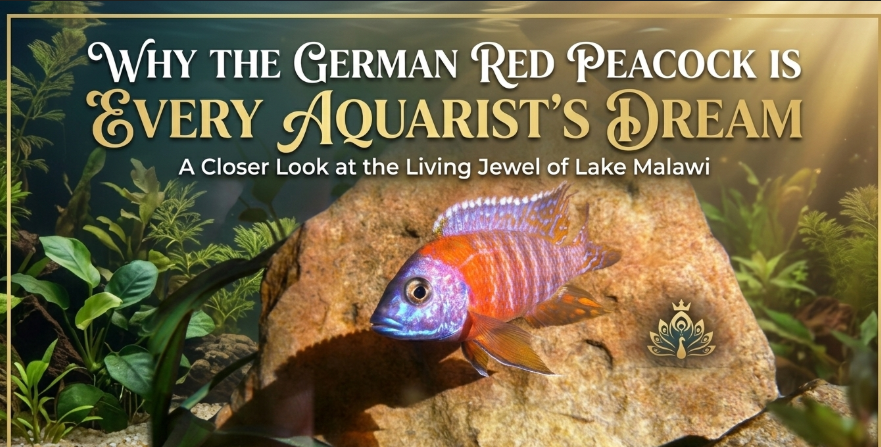
German Red Peacock (vibrant peacock) is in high demand worldwide among aquarium hobbyists for its beauty and ease of care.
This colorful fish, a member of the Lake Malawi cichlid group, is highly noticeable, with small blue dots on the face that add a nice touch to any home aquarium.
Recent studies indicate that over 76 million freshwater fish are kept in households in the United States, and there is growing demand for visually appealing, robust species (Gitnux, 2023).
This guide explains why this vibrant peacock cichlid is the dream of aquarists, a perspective rarely discussed by other professionals.
What is the German Red Peacock Fish?
It is a red-orange Malawi peacock, a freshwater cichlid from the genus Aulonocara, known for blue facial pigmentation and a relatively calm temperament in home aquariums.
German red peacock African cichlid, derived from the species found in Lake Malawi. Aquarists value this fish for its brilliant color, semi-aggressive character, and flexibility in well-maintained freshwater tanks.
Read more: Peacock Cichlid Fish Guide for Beginners and Enthusiasts
What Makes German Red Peacock Better Than Ruby Red?
These peacock cichlids are generally less aggressive, more adaptable, and more colorful.
| Feature | German Red Variant | Ruby Red Peacock |
| Color Intensity | Dark red-orange with blue accents | Deeper ruby-red, sometimes muted under light |
| Temperament | Semi-aggressive; males are territorial but manageable | Often more aggressive in mixed tanks |
| Tank Adaptability | Thrives in 55+ gallon community or species-specific tanks | Requires stricter monitoring |
| Breeding | Easier in home aquariums with proper female selection | Sometimes sensitive to water changes |
The species adapts easily to moderate water hardness and is useful to hobbyists with varying tap water conditions. Their adaptability makes them suitable for a wide range of aquarium setups.
Read more: Ruby Red Peacock Cichlid Care Secrets Every Owner Needs
What Tank Setup Helps This Peacock Cichlid Thrive?

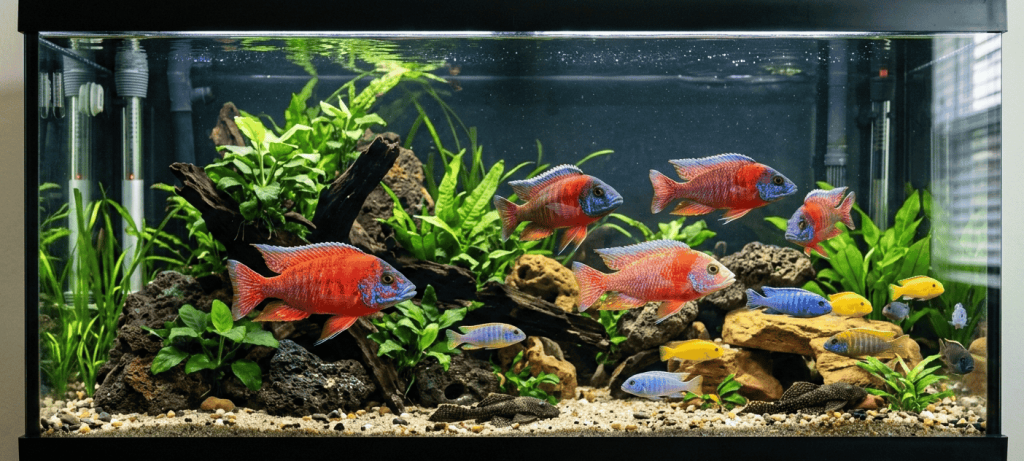
Open swimming space, a sandy substrate, hiding spots, and controlled lighting create the best aquarium environment.
To enrich the tank environment:
- Slightly inclined sandy areas allow natural foraging.
- Flat stones or caves interrupt the line of sight and decrease male competition.
- LED lights recreate the cyclic light patterns of nature, which boosts coloration.
- Selective live plants, such as Anubias or Java fern, offer shelter without stressing males.
Water Parameters:
- Temperature: 75–82°F
- pH: 7.6–8.4
- Hardness: 10–20 dGH
How Diet Enhances Color and Health
Carotenoid supplements and quality cichlid formulas are used to maintain bright coloration and health.
Recommended diet:
- Fluval Bug Bites Cichlid Formula
- Hikari Cichlid Gold
- Periodic color additives, including frozen brine shrimp or krill.
Pro Tip: To increase redness, feed small portions of carotenoid-rich food in the early evening. Coloration can be dulled by overfeeding or improper feeding, which is often overlooked in beginner aquarium guides.
Can Red Peacock Cichlids Be Kept With Blue Neon Peacocks?
Yes, through proper tank planning and monitoring.
- To minimize aggression, keep one male with 2-4 females.
- Install physical obstacles to break continuous sight lines in battles.
- Provide Blue Neon Peacocks with hiding areas because they are inherently shy.
These Aulonocara cichlids are semi-aggressive and, in 55+ gallon tanks with smaller and fast-moving species, can be kept when proper stocking guidelines are followed.
Read more: Discovering the Stunning Red Peacock Cichlid: Care and Colors
How to Breed Successfully
Breeding requires stable water, a healthy female peacock cichlid, and tank preparation.
Rarely discussed tips:
- Female selection: Healthy females produce stronger fry with higher survival rates.
- Territory control: Male stress is minimized by separate breeding areas.
- Substrate: Lake Malawi is imitated with fine sand to keep fry alive.
- Pre-spawning diets: Provide high-protein foods 1–2 weeks before spawning to enhance fertility and coloration.
Real-World Hobbyist Experiences
Tanks with one male and 2–4 females kept alongside peaceful Blue Neon Peacocks have shown good results, as reported in forum discussions, including Cichlid-Forum.
- Hobbyists report consistent, bright coloration with high-quality diets and full-spectrum lighting.
- Minimal aggression with hiding spaces and territory management
- Successful fry production under optimal conditions
The experiences verify that this peacock cichlid strain is robust, colorful, and simple to keep in a home aquarium. (Cichlid-Forum discussion)
Why Every Aquarist Should Consider This Peacock Cichlid
- Exotic visual appeal: Red-orange body with blue facial highlights.
- Interest in behavior: Social signaling and semi-aggression add to aquarium dynamics.
- Resilience: Support small water changes, compared to other Aulonocara species.
- Compatibility: Compatible with selective community species.
Conclusion
The German Red Peacock cichlid is not only a colorful fish but a centerpiece in a home aquarium that gives back on close maintenance, behavior observation, and tank beautification.
This beautiful peacock cichlid is capable of being a focal point of any freshwater aquarium with the necessary arrangement, diet, and social structure.
Get more professional guides at Peacock Cichlid Zone to make your aquarium a success, have healthy and happy cichlids.
FAQs
1. What is the difference between a German Red Peacock and a Ruby Red Peacock?
These cichlids are light blue and red-orange, and their personalities are less tense than the Ruby Reds, which are dark with ruby colour and may be slightly difficult to handle.
2. How long does it take for a juvenile male to develop full red coloration?
It also takes 8-12 months, depending on the conditions of diet, light, and water quality. Stable states promote colorful coloration.
3. What foods or supplements intensify red pigment?
Quality flakes, bug bites, frozen brine shrimp, krill, and carotenoid supplements increase coloring, particularly under bright light.
4. Can German Red Peacocks be kept with Blue Neon Peacocks without crossbreeding?
Yes, in large tanks with hiding areas, the right male-to-female ratio, and avoiding stress and aggression.
5. How many females per male prevent aggression?
1 male and 2-4 females will be balanced, reducing territorial conflicts.
6. Are German Red Peacocks more aggressive than other Aulonocara species?
They are semi-aggressive and can be controlled in well-planned community or species-specific tanks.
7. How to distinguish high-quality “show grade” German Red from lower-grade?
Show-grade fish are brighter, have consistent red-orange color, vivid blue colors, symmetrical fins, and healthy proportions.
8. Do they require specific lighting for red scales?
Yes. Full-spectrum LED lighting in aquariums enhances the natural red-orange coloration of the species and reveals blue facial markings, resulting in this peacock cichlid appearing more vivid in the domestic aquarium.
9. Can they live peacefully with non-cichlids like Tetras or Barbs?
Yes, in large tanks with hiding spots, but aggression may occur in the smaller aquariums.
References:
Neural Innervation as a Trigger of Morphological Color Change and Sexual Dimorphism in Cichlid Fish
https://www.nature.com/articles/s41598-020-69239-w
Pigmentation Potentially Influences Fish Welfare in Aquaculture
https://www.sciencedirect.com/science/article/abs/pii/S0168159123000758
Habitat Light Sets the Boundaries for Rapid Evolution of Cichlid Fish Vision
https://onlinelibrary.wiley.com/doi/full/10.1111/mec.15416
Aulonocara stuartgranti, Species Summary
https://www.fishbase.se/summary/SpeciesSummary.php?genusname=Aulonocara&speciesname=stuartgranti
Phylogenetic Analysis of Core Melanin Synthesis Genes, Albinism in Fish