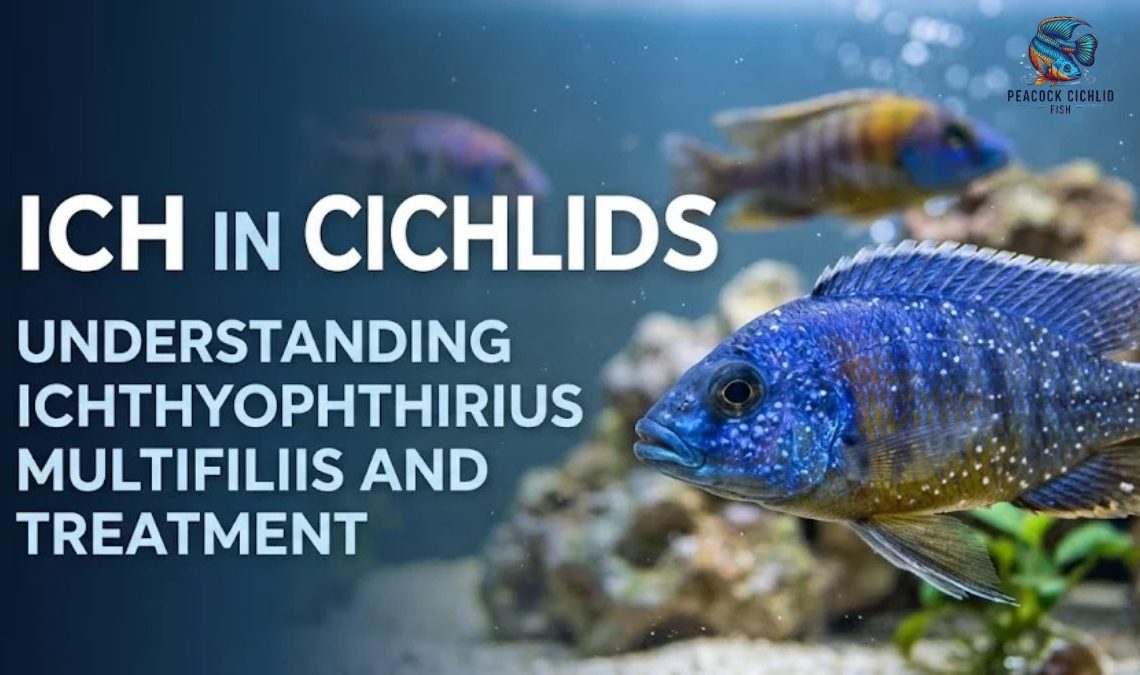
Seeing tiny white spots appear across your cichlid can be alarming. What looks like a few harmless specks may signal a contagious parasite spreading through the aquarium.
Ich in cichlids develops from Ichthyophthirius multifiliis, a freshwater parasitic protozoan. Aquarists commonly call it ich, ick, or white spot disease. The parasite can affect the skin, fins, and gills; severe infections can cause breathing problems and even death.
Early recognition gives you a better chance to control an outbreak. Understanding how ich develops also explains why treatment requires patience and repeated attention.
This guide explains what causes ich, how to recognize it, how the parasite spreads, and how to treat and prevent it in cichlids.
What Is Ich in Cichlids?
Ich is a contagious freshwater parasitic infection caused by Ichthyophthirius multifiliis. The condition usually appears as tiny white spots that resemble grains of salt.
The parasite can infect many freshwater fish species, including cichlids. It follows a direct life cycle that allows the parasite to move between an infected fish and the aquarium environment.
Is Ich the Same as Ick Fish Disease?
Yes. Ich and ick usually describe the same freshwater fish disease.
You may also see terms such as white spot disease fish, ich disease fish, and white spot disease cichlid used online. These names generally refer to the same parasite when the discussion involves Ichthyophthirius multifiliis.
Is Freshwater Ich the Same as Marine Ich?
No. Freshwater ich comes from Ichthyophthirius multifiliis, while marine ich involves Cryptocaryon irritans.
Although both conditions can produce white spots, their biology and treatment differ. This article focuses specifically on freshwater ich affecting cichlids.
What Causes Ich in Cichlids?
Ich starts when infectious parasite stages reach a susceptible fish. New fish are one of the most common ways ich enters an established aquarium.
However, fish are not the only possible source. Contaminated plants, decorations, nets, siphons, buckets, and other wet equipment can also move the parasite between systems.
Can New Fish Bring Ich Into an Aquarium?
Yes. A new fish can carry ich before obvious white spots appear.
Transportation and environmental changes can also stress a newly introduced fish. Stress does not create ich, but it can make disease management more difficult.
That is why quarantine remains one of the most useful disease-prevention steps for cichlid keepers.
Can Aquarium Equipment Spread Ich?
Yes. Shared aquarium equipment can transfer infectious stages between tanks.
Keep separate nets, buckets, and siphons for quarantine systems whenever possible. Clean and disinfect equipment before moving it between aquariums.
Does Poor Water Quality Cause Ich?
Poor water quality does not directly create ich. However, unstable conditions can increase stress and make an infected fish harder to manage.
Ammonia, nitrite, low oxygen, and sudden temperature changes can also cause symptoms that look similar to ich.
When a cichlid suddenly behaves differently, test the water before assuming every symptom comes from the parasite.
What Does Ich Look Like on a Cichlid?
The classic sign involves small white spots on the body or fins. These spots often look like grains of salt sprinkled across the fish.
However, appearance alone cannot confirm ich. Other conditions can produce similar marks, while gill infections may cause serious symptoms without visible spots.
What Do White Dots on a Cichlid Body Mean?
Several tiny white dots across the body can strongly suggest ich, especially when flashing or breathing problems occur at the same time.
The visible spot develops around a parasite located within the fish’s epithelial tissue. As the infection progresses, more spots may appear across the body.
Can Ich Cause White Spots on Fins?
Yes. Ich can affect the fins as well as the body.
When inspecting a suspected infection, look closely at the dorsal, caudal, anal, and paired fins. White spots on several fins can support suspicion of ich, particularly when behavioral changes occur too.
Can Ich Affect the Gills Without White Spots?
Yes. This is an important detail that many aquarists overlook.
A cichlid can develop gill involvement without obvious white spots on the body. Rapid gill movement, surface gasping, weakness, and lethargy may become the main warning signs.
What Are the Early Signs of Ich in Fish?
The early signs of ich in fish may appear before a heavy coating of white spots develops. Behavioral changes often provide the first clue that something is wrong.
Watch for:
- Repeated flashing or rubbing against objects
- Faster-than-normal gill movement
- Hiding or unusual inactivity
- Reduced appetite
- Clamped fins
- Surface gasping
- Increased mucus
- Small white spots on the body or fins
These signs do not prove ich on their own. Water-quality problems and other parasites can cause similar symptoms.
Why Does a Cichlid Flash Against Rocks?
Flashing occurs when a fish repeatedly rubs its body against rocks, decorations, or substrate.
External parasites can irritate the skin and trigger this behavior. Ich can cause flashing, but other parasites and environmental problems can cause it too.
Why Is My Cichlid Breathing Rapidly?
Rapid breathing can indicate respiratory stress.
Ich can cause this problem when parasites affect the gills. Low dissolved oxygen, ammonia, nitrite, and other conditions can create similar breathing changes.
If rapid gill movement appears suddenly, check water quality and oxygen levels immediately.
How Does Ich Spread Through a Cichlid Aquarium?
Ich has a lifecycle that moves between the fish and the aquarium environment. This process allows the parasite to multiply and infect additional fish.
One infected cichlid can therefore expose an entire aquarium when conditions support parasite development.
Can One Infected Fish Infect the Whole Tank?
Yes. Ich can spread quickly through a shared aquarium.
The parasite does not need another animal species to complete its lifecycle. Once infectious stages enter the water, other susceptible fish can become exposed.
That makes an aquarium-wide approach important when managing an outbreak.
What Is the Ich Life Cycle?
Understanding the lifecycle of Ichthyophthirius multifiliis makes treatment much easier.
The parasite moves through three important stages: trophont, tomont, and theront.
What Is the Trophont Stage?
The trophont is the feeding stage found on the fish. It develops within epithelial tissue of the skin or gills. Surrounding tissue and mucus protect it, making this stage difficult for many treatments to reach.
The familiar white spot develops around the parasite during this stage.
What Is the Tomont Stage?
A mature trophont eventually leaves the fish and becomes a tomont.
The tomont forms a protective cyst on an aquarium surface. It then divides repeatedly inside the cyst.
Under favorable conditions, one tomont can produce up to 1,024 daughter parasites. This reproductive potential explains how quickly a small outbreak can become serious.
What Is the Theront Stage?
The theront is the free-swimming infectious stage. It leaves the cyst and searches for a suitable fish host. This stage remains much more vulnerable to chemical treatment than the protected stages.
Why Does the Lifecycle Matter During Treatment?
The lifecycle explains why one treatment dose rarely eliminates ich.
Many treatments primarily affect the free-swimming stage. The trophont and tomont remain protected at other points in the lifecycle.
Repeated treatment helps target new infectious stages as they emerge.
How Do You Diagnose Ich in Cichlids?
White spots can raise suspicion, but visual inspection cannot always confirm the diagnosis.
A microscope provides much stronger evidence when the diagnosis remains uncertain.
Is Every White Spot Ich?
No. Injuries, fungal growth, other parasites, and some diseases can create similar-looking marks.
Look at the complete picture. White spots combined with flashing, rapid breathing, appetite loss, and other classic signs raise suspicion.
How Is Ich Confirmed?
A fish-health professional can examine skin mucus, fin tissue, or gill tissue under a microscope.
Microscopic examination can identify Ichthyophthirius multifiliis and help distinguish it from other causes of white spots.
How to Treat Ich in Cichlids
Successful treatment requires more than adding a medication once. The aquarium needs stable water, adequate oxygen, an appropriate treatment method, and enough time to address the parasite’s lifecycle.
1. Test and Correct Water Quality
Start by checking ammonia, nitrite, nitrate, pH, and temperature.
Correct dangerous water-quality problems and use properly conditioned water during water changes. Avoid sudden changes that add further stress.
2. Increase Oxygenation
Strong aeration is especially important when the gills may have been damaged.
Warmer water also holds less dissolved oxygen. An air stone or increased surface agitation can help maintain adequate oxygen levels.
3. Choose an Appropriate Ich Treatment
Commercial freshwater ich treatments can target vulnerable parasite stages.
Choose a product specifically labeled for aquarium fish. Follow the manufacturer’s instructions carefully rather than increasing the dose when symptoms look severe.
4. Complete the Treatment Course
Do not stop treatment simply because the white spots disappear.
Visible parasites may leave the fish while other stages remain in the aquarium. Continue the complete treatment schedule recommended for the selected product.
5. Monitor the Aquarium
Check the cichlids every day during treatment.
Watch for breathing, appetite, swimming, coloration, and new spots. Continue monitoring ammonia and nitrite.
Can You Treat Ich Without Medication?
Some aquarists search for ich treatment without medication. Temperature management and increased salinity can support specific treatment approaches.
However, these methods do not suit every aquarium. Fish tolerance, plants, tank mates, water chemistry, and oxygen levels all need consideration.
Does Raising Temperature Treat Ich?
Higher temperatures can speed up the parasite’s lifecycle.
This change can move the parasite toward its vulnerable free-swimming stage faster. However, heat does not automatically kill every parasite.
Higher temperatures can also lower dissolved oxygen. Strong aeration becomes especially important when using temperature as part of an ich-control strategy.
Can Salt Treat Ich in Cichlids?
Yes. Increased salinity can help control ich in suitable freshwater systems.
UF/IFAS recommends 4–5 g/L of sodium chloride for seven to ten days at approximately 75–79°F, provided the fish can tolerate that concentration.
That does not make 4–5 g/L a universal dose for every cichlid aquarium. Plants and other tank inhabitants may not tolerate increased salinity.
Is Salt Safe for Peacock Cichlids?
Salt tolerance depends on the fish and the overall aquarium setup.
Before using salt, consider every species in the tank. Measure salt accurately instead of guessing.
Should You Use Copper for Ich?
Copper can control ich, but it requires careful handling.
Copper becomes particularly dangerous when water alkalinity is low. Do not improvise copper sulfate doses without understanding the aquarium’s water chemistry.
For home aquariums, use a properly labeled product and follow its instructions.
Should You Treat the Whole Tank?
Ich requires attention beyond the fish showing visible spots.
Environmental stages can remain on aquarium surfaces, substrate, and debris. Treating only one visibly affected fish may not control the entire infection cycle.
When Can a Hospital Tank Help?
A hospital tank can provide a controlled environment for treatment.
Use appropriate filtration, temperature control, and strong aeration. A separate tank can also protect plants or sensitive tank mates from certain treatments.
Can Cleaning Help During Ich Treatment?
Yes. Cleaning can remove debris and cyst-bearing material from the aquarium.
Regular substrate maintenance and careful waste removal can support treatment by reducing environmental parasite stages.
How Long Does Ich Treatment Take?
Treatment duration depends on water temperature, parasite development, treatment method, and product instructions.
Do not use the disappearance of white spots as the only reason to stop treatment.
Why Do White Spots Disappear Before Ich Is Gone?
The trophont eventually leaves the fish and develops into a tomont in the environment.
The cichlid may therefore look better while the parasite continues developing in the aquarium. New theronts can later emerge and reinfect fish.
How Many Treatments Does Ich Need?
Treatment schedules vary with temperature and treatment method.
At approximately 75–79°F, UF/IFAS describes repeated chemical treatments because new vulnerable stages continue to emerge.
Commercial treatments may use different schedules. Follow the instructions for the specific product rather than combining unrelated treatment protocols.
How Can You Prevent Ich in Cichlids?
The best time to manage ich is before it enters the display aquarium.
Good prevention combines quarantine, stable water, equipment hygiene, and stress reduction.
Quarantine New Fish
Keep new cichlids in a separate quarantine aquarium before introducing them to established fish.
Observe behavior, appetite, breathing, and physical changes during quarantine. Treat suspected disease before moving the fish into the main aquarium.
Keep Equipment Separate
Use dedicated nets, buckets, and siphons for quarantine systems.
If equipment must move between aquariums, clean and disinfect it appropriately first.
Maintain Stable Conditions
Avoid sudden temperature and water-chemistry changes.
Test the aquarium regularly and address ammonia or nitrite problems quickly. Stable conditions reduce unnecessary stress and support healthier fish.
Can Peacock Cichlids Recover From Ich?
Many cichlids can recover when aquarists identify and manage the infection promptly.
Recovery depends on the parasite burden, gill involvement, water quality, treatment success, and the fish’s overall condition.
What Should You Monitor During Recovery?
Continue watching appetite, breathing, swimming, coloration, and interactions with other fish.
Maintain excellent water quality even after visible spots disappear. Give the fish time to regain normal behavior and condition.
When Should You Seek Professional Help?
Seek professional fish-health advice when fish show severe breathing difficulty, sudden deaths, repeated treatment failure, or unexplained illness.
Microscopic testing can provide a clearer diagnosis when symptoms do not match classic ich.
Final Thoughts
Ich can begin with a few tiny white spots, but the parasite can quickly become an aquarium-wide problem.
The key lies in understanding the parasite rather than reacting only to visible spots. Ichthyophthirius multifiliis moves through protected and vulnerable stages, which makes repeated treatment essential.
For peacock cichlid keepers, early action matters. Watch for flashing, rapid gill movement, clamped fins, surface gasping, loss of appetite, and unusual behavior.
Test the water, improve oxygenation, choose an appropriate treatment, and follow the complete treatment schedule.
Most importantly, focus on prevention after the outbreak ends. Quarantine new fish, maintain stable conditions, keep equipment clean, and monitor the aquarium regularly.
A few white spots deserve attention. Acting early can help protect the rest of your cichlid community.
FAQs
What is ich in cichlids?
Ich is a freshwater parasitic infection caused by Ichthyophthirius multifiliis. It commonly produces small white spots on the skin or fins.
Is ich the same as ick fish disease?
Yes. Ich and ick usually describe the same freshwater fish disease.
Can peacock cichlids get ich?
Yes. Peacock cichlids can develop ich after exposure to Ichthyophthirius multifiliis.
What are the early signs of ich in fish?
Early signs can include flashing, hiding, reduced appetite, clamped fins, rapid breathing, and unusual swimming.
Can ich affect cichlid gills without white spots?
Yes. Gill infections can cause rapid breathing or surface gasping without obvious spots on the body.
Can salt treat ich in cichlids?
Yes. Increased salinity can help control ich when the fish and other aquarium inhabitants tolerate it.
Why did the white spots disappear but my cichlid still look sick?
The visible parasite may have left the fish while other lifecycle stages remain in the aquarium.
How can I prevent ich in my cichlid aquarium?
Quarantine new fish, maintain stable water, use separate equipment, and monitor new arrivals before introducing them to the display aquarium.
Can cichlids survive ich?
Many cichlids can recover with timely and appropriate treatment. Severe infections can cause serious tissue and gill damage and may become fatal.
Also Read: 18 Peacock Cichlid Disease: Symptoms, Causes, and Treatment Guide
References;
Infections in Fish (CIR920/FA006). UF/IFAS Extension, University of Florida.
https://edis.ifas.ufl.edu/publication/FA006
Ewing, M. S. (2014). 3.2.8 Ichthyophthiriasis. In FHS Blue Book: Suggested Procedures for the Detection and Identification of Certain Finfish and Shellfish Pathogens. American Fisheries Society, Fish Health Section
https://fhs.fisheries.org/wp-content/uploads/sites/39/2017/08/3.2.8-Ichthyophthiriasis-2014.pdf
Forwood, J. M., et al. (2015). Life cycle and settlement of an Australian isolate of Ichthyophthirius multifiliis Fouquet, 1876 from rainbow trout. Folia Parasitologica, 62, 013.
https://doi.org/10.14411/fp.2015.013
Fournie, J. W. Parasitic Diseases of Aquarium Fishes. IAAAM Archive, Gulf Coast Research Laboratory
https://www.vin.com/doc/?id=3863674
