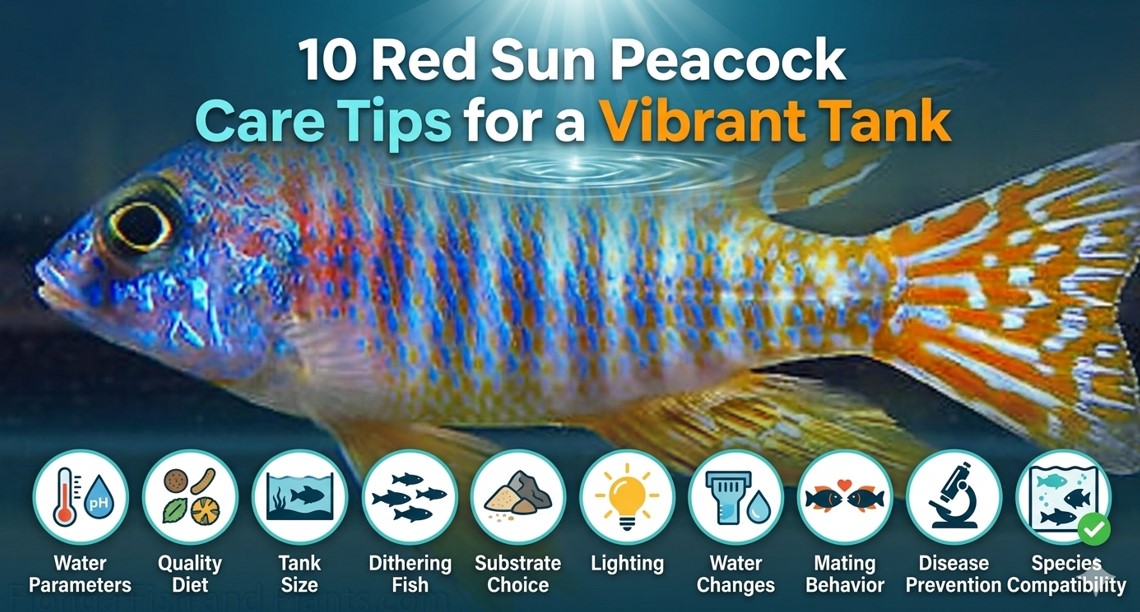
The Red Sun Peacock cichlid is not simply an aquarium fish; it is a living jewel. Its glossy, red, and orange colours make an ordinary tank appear remarkable at a glance. That is why it is necessary to care about it.
Red Sun Peacocks are in demand and highly valued as the freshwater aquarium market accounts for more than 75% of the world’s ornamental fish trade (Wifitalents, 2023).
Various hobbyists specialize in routine measures; a few of them attend to details that maintain the vibrancy and natural behavior. This guide explores those lesser-known insights for “Red Sun” Peacocks.
Understanding the Red Sun Peacock Cichlid
The Red Sun Peacock is a line-bred variety of Aulonocara African cichlids, selected because of its deep red color. With proper care, these fish display their colors better in a home aquarium than in the wild-type peacock.
- One of the Aulonocara species, native to Lake Malawi.
- The males are colorful, whereas the females are dull.
- “Albino Red Sun” Peacock variants are increasingly popular for a softer, ethereal look.
Read more: Peacock Cichlid Fish Guide for Beginners and Enthusiasts
Essential Red Sun Peacock Care Guidelines
These cichlids need an understanding of their unique behavior, environmental, and food demands to be managed appropriately.
1. Choose the Right Tank Size
Red Sun Peacocks are fairly territorial. 55 gallons is the right size to keep one fish; 75 or more to keep a group of males. Sufficient space promotes natural behavior and growth as well as vivid coloration.
2. Maintain Stable Water Parameters
Keep 7.8-8.6 pH, 76-82°F, and medium to high hardness. Stable water helps to keep bright pigments and disease away.
3. Feed a Color-Enhancing Diet
To maintain redness, an orange color, and balanced nutrition, feed carotenoid-enriched pellets, spirulina, and some live/frozen foods.
4. Provide Soft Substrate and Caves
Without injury, fine sand or smooth gravel can be dug. Include rocks and caves to minimize aggression and Lake Malawi habitats.
5. Select Compatible Tank Mates
Auratus, Blue Dolphin, or Yellow Lab are peaceful Malawi cichlids that work well. Eliminate small or highly aggressive species to decrease stress.
6. Create Visual Territories
Break sightlines with rocks or décor to reduce male aggression and give females safe zones.
7. Monitor Health Closely
Observe Malawi bloat, white spot, and fungal infections. Isolate fresh fish and check frequently.
8. Control Lighting and Seasonal Conditions
Proper lighting enhances color. Adjust diet and water care during seasonal temperature changes to support metabolism and reduce stress.
9. Support Breeding Successfully
Red Sun Peacocks are freshwater cichlids. Add 1 male and 2-3 females to a breeding tank with hiding places. Monitor behavior to improve fry survival.
10. Practice Patience and Observation
Observe feeding, territory interactions, and movement. Modify tank layout, diet, or tank mates to ensure harmony and coloring.
Quick Care Reference Table
| Aspect | Recommendation |
| Tank Size | 55–75 gallons |
| Water pH | 7.8–8.6 |
| Temperature | 76–82°F (24–28°C) |
| Diet | Spirulina, live/frozen food, pellets. |
| Substrate | Sand or fine gravel |
| Decor | Rocks, caves, and selective plants |
| Compatibility | Peaceful Malawi cichlids |
| Adult Size | 5–6 inches |
| Aggression | Moderate, territorial males |
Conclusion
Feeding and water changes are not the only activities of taking care of “Red Sun” Peacock cichlids. Healthy and vibrant fish will be achieved through balanced tank size, water chemistry, water diet, territory management, and observation.Read about the more professional guides at Peacock Cichlid Zone to make your cichlids thrive.
FAQs
1. What is the minimum tank size required for a “Red Sun” Peacock Cichlid?
At least 55 gallons; 75 gallons recommended for multiple adults.
2. How do you distinguish between a male and a female “Red Sun” Peacock?
The males are bright red with long fins, but the females are smaller and have dull colors.
3. What is the ideal water pH and temperature for these African cichlids?
Maintain the pH of the water between 7.8 and 8.6 and the temperature 76 to 82°F (24- 28°C).
4. What is the best diet to enhance and maintain their vibrant red and orange coloration?
Feed on a mixture of high-quality pellets, spirulina, and a selection of live or frozen foods.
5. How big do “Red Sun” Peacock Cichlids typically grow as adults?
Adults grow to 5-6 inches in domestic aquariums.
6. Which fish are the most compatible tank mates for a “Red Sun” Peacock?
The peaceful Malawi cichlids, such as Auratus, Blue Dolphin, or Yellow Lab.
7. Are “Red Sun” Peacocks more aggressive than other species from Lake Malawi?
They are reasonably aggressive, and in particular in males defending territory.
8. What type of substrate and decor should be used in their aquarium setup?
Smooth gravel or fine sand, rocks, caves, and some live plants.
9. How do you successfully breed “Red Sun” Peacocks in a home aquarium?
One male and 2-3 females in an individual breeding tank, with constant water conditions and the fry having hiding places.
10. Is the “Red Sun” Peacock a naturally occurring species or a line-bred variant?
It is a line-bred version of Aulonocara African cichlids that has been selected due to its extreme red colour.
References:
Carotenoid Coloration and Gene Expression in Red Tilapia Tissues
https://pubmed.ncbi.nlm.nih.gov/34563199
Enhancing Colouration of Marine Ornamental Fish Using Natural and Synthetic Astaxanthin
https://www.sciencedirect.com/science/article/abs/pii/S2211926418309354
Aulonocara hansbaenschi Conservation Status
https://www.iucnredlist.org/species/61065/47231808
Aulonocara hansbaenschi, Species Summary
https://www.fishbase.se/summary/SpeciesSummary.php?genusname=Aulonocara&speciesname=hansbaenschi
Replacement of Fish Meal with Fermented Plant Proteins in Aquaculture Diets

I’ve always loved the Red Sun Peacock because of its incredible colors, and this guide was super helpful. The care tips were easy to follow, and I learned a few things I didn’t know about tank setup and feeding. Thanks for sharing such useful information!