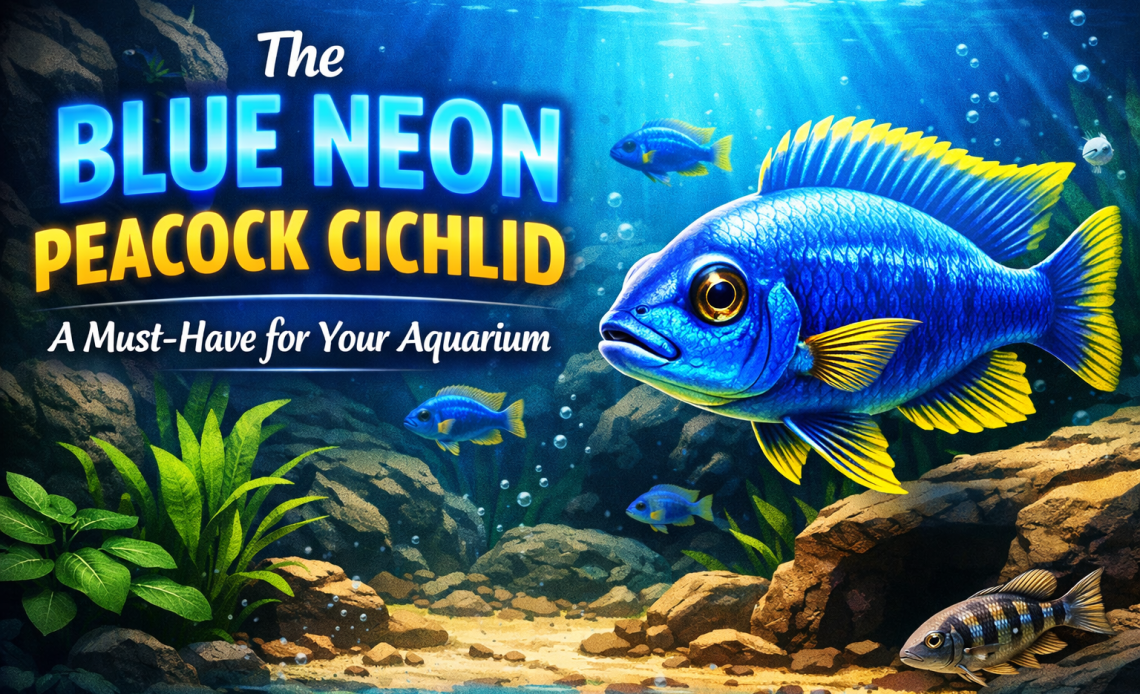
Aquarium hobbyists often desire fish with impressive coloration, stress-free behavior, and low-maintenance requirements. The Blue Neon Peacock Cichlid is one of the most striking freshwater fish, with an electric-blue body and a few yellow dots.
As the ornamental fish hobby grows, statistics indicate that the freshwater fish industry accounts for more than 75 percent of the global aquarium market (Wifitalents, 2023). This indicates the increasing need for visually active and versatile species.
Investing in Blue Neon Peacock Cichlids not only helps beautify home aquariums but also creates a healthy and fulfilling environment for the tank mates. The beauty, nature of peace, and communication offer a guarantee of something that both the amateur and the advanced hobbyist need.
What Makes the Blue Neon Peacock Cichlid So Unique?
It is a unique option due to its neon colors and serene atmosphere.
Aulonocara stuartgranti, also known as the Blue Neon Peacock, is a widely known fish species because it is electric blue in color with yellow spots on its body. They are also semi-aggressive, like the other cichlids, and they can be housed together. Most hobbyists do not notice that even minor color differences on the back can signify health and breeding readiness, as in the blue neon dorsal peacock.
- They have sensory pits on their heads that sense movement and vibrations to improve feeding efficiency (Albertson et al., 2023).
- They react favorably to environmental enrichment such as rock caves and calm water flow.
- They vary in coloration intensity with mood, breeding preparedness, and tank light spectrum.
Read more: Peacock Cichlid Varieties
What Is the Average Size of a Blue Neon Peacock Cichlid?
Adults grow up to 10-12 cm, depending on the treatment and setting.
Most aquarists fail to appreciate the impacts of tank size and diet on adult size. Blue Neon African Cichlids kept in well-oxygenated and nutrient-rich tanks develop better coloration and healthier growth. They are slightly smaller than Mbuna cichlids but possess more intense neon coloration and are much desired in decorative use.
- Males are typically slim and brighter than females.
- Quality protein-based diets increase growth.
- Stress, low water quality, or congestion can prevent growth or dull colors.
What Tank Size Is Ideal for Blue Neon Peacock Cichlids?
For 1–3 Blue Neon Peacock Cichlids, a tank of at least 200–250 liters provides enough space for healthy growth and natural behavior.
Most guides recommend regular tanks, and Blue Neon Peacock Cichlids are comfortable in long tanks with sandy bottoms where they are able to excavate naturally. Compared to gravel, sand minimizes stress and maximizes the expression of natural colors (MDPI, 2023).
Tank Setup Essentials
- Fine sand to depict the floor of Lake Malawi.
- Rock caves and a few plants to avoid dispute over territory.
- Use moderate filtration to simulate natural water flow.
Which Tank Mates Are Most Compatible?
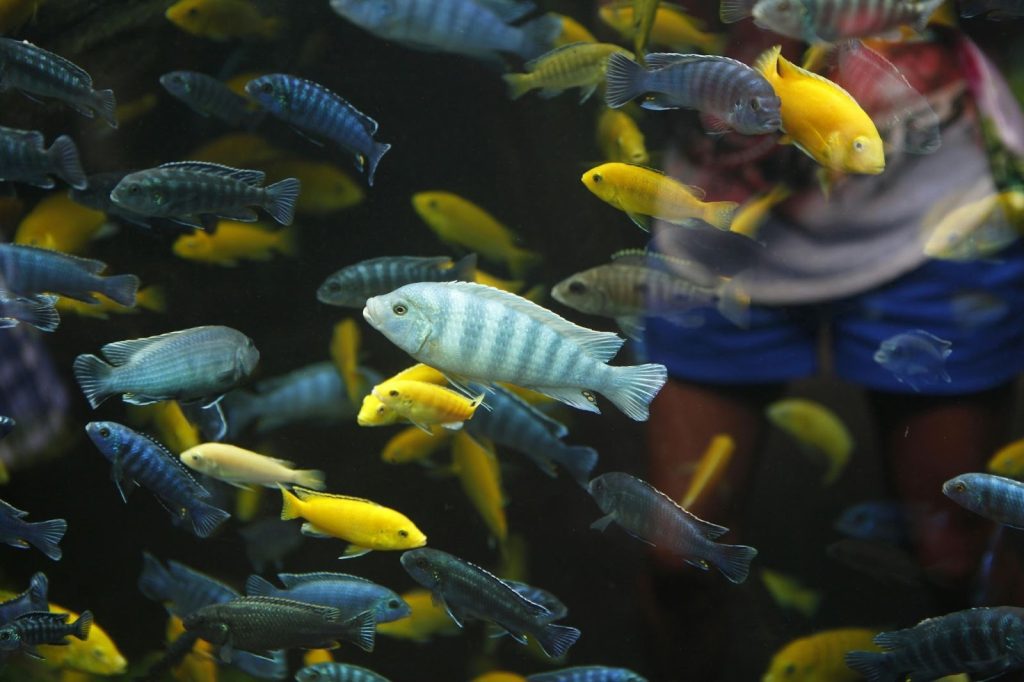
They coexist with peaceful cichlids and other community fish of equal size.
Most cichlids are aggressive, but Blue Neon Peacock Cichlids have peaceful social lives. They bind well with other peacock variants and small catfish, but not very territorial fish such as some Mbuna types.
Key Compatibility Tips
- Keep the ratio 1:2 male to female to control aggression.
- There should be no overcrowding, and this will cause territorial conflict.
- Offer hiding places with visual obstructions, such as rocks.
What Should You Feed Blue Neon Peacock Cichlids?
Colorful coloration is achieved through the use of live or frozen food (eventually) and high-protein pellets.
Unlike the usual freshwater fish, Blue Neon Cichlids display their neon optimum when they are fed a carotenoid and spirulina diet. Most first-time guides do not give much consideration to the importance of supplementary live food for breeding and coloration.
Feeding Recommendations
- Balanced nutrient pellet food.
- Bloomworms, Daphnia, and Brine Shrimp.
- Spirulina flakes and carotenoid-enriched foodstuffs.
How Do You Maintain Water Quality for Blue Neon Peacock Cichlids?
Fish have to be tested, filtered, and replaced with water periodically to survive.
Blue Neon Peacock Cichlids are sensitive to sudden changes in water level. The hardness, temperature, and pH are maintained at their natural Lake Malawi conditions. The role of micro-nutrient balance in water that influences coloration and health is also not taken into account by most hobbyists.
Water Maintenance Tips:
- 7.8–8.6 for optimal health.
- 24-28 degC, with small daily variations.
- Moderate flow that contains both biological and mechanical filtration.
- Replace the water every 25-30% weekly to eliminate toxins.
- To simulate lake conditions, add mineral-rich calcium to enable the bones to develop.
How to Breed Blue Neon Peacock Cichlids Successfully
Place the fish in a separate breeding tank with hiding spots and stable water conditions.
Breeding Insights Rarely Discussed
- Females carry eggs in their mouths for up to three weeks.
- The males enhance the blue neon peacock coloration through mating behavior.
- Sand substrate, rock caves, and weak filtration.
- Freshly hatched brine shrimp or special fry food must be fed to promote healthy growth.
Common Health Concerns and How to Prevent Them
Proper care, clean water, and the absence of stress can prevent natural disease.
Health Tips
- Dark color, reduced activity, and compressed fins.
- Ich, fin rot, and parasitic infections.
- Keep the fresh fish isolated, keep tanks clean, and do not overcrowd.
- Vitamin-enriched food is taken now and then in order to boost immunity and color.
How to Replicate Their Natural Habitat
Model Lake Malawi using sand, rocks, and constant water parameters.
Most hobbyists ignore environmental authenticity, which directly affects behavior and coloring. Blue Neon Peacock Cichlids are more secure and exhibit clearer neon colors in sandy habitats and rocky caves.
Habitat Recreation Tips
- Natural digging and breeding behavior are possible with fine sand.
- Mimic crevices of the lake to claim territory and hide.
- Medium intensity to increase neon blue peacock shine.
- Low-maintenance and hardy plants such as Anubias or Java Fern.
Expert Tips for Long-Term Happiness and Color Enhancement
Enrichment, appropriate feeding, and stable conditions enhance health and coloration.
Pro Tips Rarely Discussed
- Occasionally, change the decorations on the rotating tank to decrease boredom and promote exploration.
- To increase blue and yellow colors, consume spirulina-enriched and carotenoid foods.
- Add soft streams of water to replicate a natural lake’s environment.
- Monitor daily behavior, active males are a sign of good environmental conditions and approaching mating.
Real-World Case Study: Home Aquarium Success
Research in the industry indicates that breeding ornamental fish has emerged as a significant sector of aquaculture, and breeders have selectively advanced characteristics such as color and adaptability in freshwater species, such as cichlids, to captive aquarium ware (OMICS, 2023).
Conclusion
The Blue Neon Peacock Cichlid is not just a good-looking freshwater fish; it is also well-suited for every home aquarium. The reason why it makes a great choice for both beginner and experienced aquarists is its bright neon blue and yellow colors, calm temperament, and flexibility.
Hobbyists are likely to have healthy and colorful ecosystems whenever they offer the correct tank size, compatible mates, a stable state of water, and a balanced diet. Not only is investing in such cichlids an aesthetic enhancement to your aquarium, but it is also a health boost.
Visit the Peacock Cichlid Zone to receive expert advice, premium fish, and the rest of the space needed to make the project successful.
FAQs
Q: What is the actual price of Blue Neon Peacock Cichlid?
By region and size, 15 to 30 per fish will be the range of the prices based on the quality of the breeder and intensity of the color.
Q: What is the minimum tank size required for a Blue Neon Peacock?
A 55-75 liter tank is required for 1-3 fish to get a possibility of swimming freely and to demonstrate their sense of territory.
Q: How do I tell the difference between a male and a female?
The males are brightly-coloured, but the females are dull and smaller.
Q: Which tank mates are most compatible with this species?
Peaceful African cichlids that are non-territorial, miniature catfish, among others. Avoid violent cichlids, Mbuna.
Q: What water pH and temperature do they need to thrive?
Optimize PH 7.8-8.6 and temperature 24-28 degC to obtain optimal health and color development.
Q: Why is my Blue Neon Peacock losing its vibrant color?
Probably, it is caused by stress, nutrition, or a fluctuation of water parameters. Provide good nutrition and environment.
Q: What is the best diet to enhance their blue and yellow pigmentation?
High-protein pellets, spirulina flakes, and carotenoid-enhanced foods can be used to increase coloration.
Q: How aggressive are they compared to Mbuna cichlids?
They are not so aggressive and therefore can be used as nonviolent tanks in a community.
Q: Why is a sandy substrate better than gravel for this fish?
Sand makes the natural digging habit possible, reduces stress, and recreates the conditions found in Lake Malawi, which enhance health and color.
References:
Aulonocara korneliae Conservation Status
https://www.iucnredlist.org/species/61067/47231913
Aulonocara korneliae, Species Summary
https://www.fishbase.se/summary/SpeciesSummary.php?genusname=Aulonocara&speciesname=korneliae
Royal Society Publishing / Proceedings of the Royal Society B
Differences in Male Coloration Predicted by Divergent Sexual Selection in Cichlid Fish Populations
https://royalsocietypublishing.org/doi/10.1098/rspb.2016.0172
Pigmentation and Coloration-Linked Gene Expression in Red Tilapia Tissues
https://pubmed.ncbi.nlm.nih.gov/34563199
Feeds and Feeding of Fish and Shrimp, A Manual on the Preparation of Compound Feeds
