


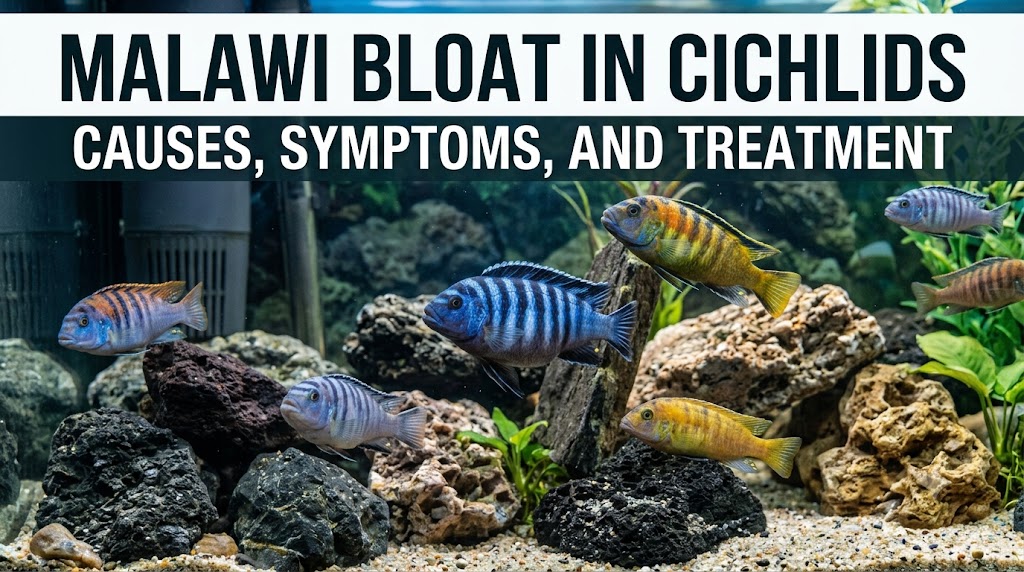
Malawi Bloat is one of the fastest-killing diseases in the African cichlid hobby, and it can wipe out a healthy-looking tank in under a week. If your cichlid has a swollen belly, stringy white poop, or has stopped eating, you are likely dealing with Malawi Bloat, and the next 24 to 48 hours matter more than you think.
This guide covers what Malawi Bloat in cichlids is, why it happens, how to spot it early, and the exact treatment steps that give your fish the best chance of survival.
According to Aquarium Science, necropsies on cichlids with bloat found intestinal bacterial infections in around 70% of cases, with the parasite Hexamita present in roughly 40%.
Fish treated in the first day or two respond far better than those left untreated, and survival odds drop sharply after that window. This article walks through every stage of the disease so you can act fast and correctly.
What Is Malawi Bloat in Cichlids?
Malawi Bloat is a digestive disease in African cichlids that causes rapid abdominal swelling, loss of appetite, and often death within days if untreated. It is not a single organism or infection, it is a syndrome, meaning several different triggers can produce the same set of symptoms.
The name comes from Lake Malawi, since mbuna and other herbivorous cichlids from that lake are hit hardest. That said, peacock cichlids, and cichlids from Lake Victoria and Lake Tanganyika get it too, so the disease is not exclusive to one lake or species.
Malawi Bloat starts in the gut. A build-up of protein-heavy waste, combined with an overgrowth of the protozoan parasite Hexamita (also called Spironucleus), damages the intestinal lining.
This allows opportunistic bacteria, including strains linked to Clostridium and Francisella, to invade and cause the swelling, fluid retention, and organ stress that define the disease.
Quick Snapshot
| Detail | Information |
| Affects | Mbuna, peacocks, haps, and other African cichlids |
| Speed | Can kill within 2 to 5 days |
| Main trigger | Diet and gut parasite overgrowth |
| Survival if caught early | Good with prompt treatment |
What Causes Malawi Bloat?
A combination of poor diet, stress, and an overgrowth of gut bacteria and parasites causes Malawi Bloat. Gut bacteria and parasites are relatively harmless, but gut bloat takes them to a different level by mixing and matching different factors, such as two or three, to create a strong gut bloat. Malawi Bloat causes stress and diet overload.
- Diet: Malawi Bloat and Herbivorous Mbuna have short guts or intestines that are designed to digest and process algae and plant matter, not proteins or meat. Feeding fish high protein pellets or flakes, freeze dried bloodworms, and other foods can be too much and overload gut Bloat. High protein foods also cause and promote gut bloat.
- Water Quality: Malawi Bloat and Mbuna fish are designed to cope with ammonia spike and nitrite water levels. Malawi Bloat causes stress and disrupts gut immunity.
- Stress and Overcrowding: New setups cause Malawi Bloat and can weaken gut lining and can also cause stress of aggressive tank mates.
Common Triggers
- Protein-rich food fed to herbivorous species
- Ammonia or nitrite spikes from an uncycled tank
- Overcrowded aquariums with high aggression
- Sudden water changes or temperature swings
- Incorrect use of aquarium salt
What Are The Early Signs of Malawi Bloat in Peacock Cichlid?
The earliest sign of Malawi Bloat is loss of appetite while gut bloat continues. This stage is the quickest recovery from a tank wide outbreak of Malawi Bloat.
In the first 24 to 48 hours, look for these signs:
- Less interest in food. May even graze on food and spit it out.
- Slight swelling around the abdomen (can be difficult to see).
- More hiding or staying at the surface.
- Gill movement is more rapid in comparison to tank-mates.
- Showing a more solitary behavior, staying in a corner (instead of schooling).
What Are The Severe Symptoms for Malawi Bloat in Cichlids?
Severe Malawi Bloat in cichlids looks like a visibly distended, ball-shaped belly along with stringy white feces and rapid, labored breathing. At this stage the fish is in real danger, and treatment needs to start immediately.
Visible Signs
- Pronounced abdominal swelling, sometimes lopsided
- Scales that begin to protrude slightly, similar to dropsy
- Pale or darkened body coloration
- Sunken eyes in advanced cases
Behavioral Signs
- Gasping at the surface or labored gill movement
- Complete refusal of food for 2 or more days
- Listing to one side or resting on the substrate
- Stringy, white, or clear mucus-like feces
Stringy white poop specifically points toward Hexamita involvement, and it is one of the most searched symptoms because it shows up before the belly swelling becomes obvious in some fish.
Is It Bloat Or Dropsy?
Malawi Bloat and dropsy both cause a swollen belly, but they are different conditions with different causes and outlooks. Telling them apart changes how you treat the fish.
| Feature | Malawi Bloat | Dropsy |
| Cause | Diet, parasites, gut bacteria | Kidney failure, systemic infection |
| Onset | Fast, within days | Slower, more gradual |
| Scales | Usually flat | Pinecone-like, sticking out |
| Species | Mainly African cichlids | Any freshwater fish |
| Outcome | Good if treated early | Generally poor |
Dropsy is typically a symptom of organ failure and carries a poor prognosis once fluid buildup has already set in, according to Chewy’s veterinary fish health guide. Malawi Bloat, by contrast, responds much better to treatment when you catch it before the scales start protruding.
How Do Vets Diagnose It?
There’s no concrete test to prove the existence of Malawi Bloat. Diagnosis comes from the symptoms, the species, history of feeding, and the pace of the illness.
A combination of visible symptoms and the process of elimination is what is most commonly used by the vet and experienced fish experts.
A diagnosis in progress commonly looks at the following:
- Species and Diet: Is the fish in question a herbivorous African cichlid and did it have a protein rich diet?
- Speed of onset: Did the swelling occur within the short span of 1 to 3 days, as opposed to weeks?
- Stool appearance: Has the fish been passing white, stringy stool?
- Water parameters: Test the ammonia, nitrite, and nitrate right away.
- Tankmates: Are the fish that have the same diet and are the same species, showing symptoms of bloat?
If most of the criteria are met, most of the fish experts begin treating Malawi Bloat as there is no time to lose when the health of the fish is at stake.
How To Treat Malawi Bloat (Step By Step)
The treatment for Malawi Bloat involves the fish being isolated and being treated with the drug Metronidazole, and it also requires the water and the diet to be simultaneously treated.
All of the steps are important in the treatment of Malawi Bloat. Skipping any of the steps would compromise the success of the treatment.
Step 1: Isolate
If it is possible to put the affected fish in a tank that is isolated and has no substrate on the bottom, do so. A tank that has no substrate will help you in both monitoring the fish and removing waste.
Step 2: Fast the fish
For the next 24 to 72 hours, do not feed the fish. This will allow the gut to clear and reduce the food source for the bacteria.
Step 3: Medicate
Begin treatment with metronidazole. This may be incorporated as medicated food if the fish is eating. If the fish is eating no longer, metronidazole should be added as a medication to the tank. Full dosing instructions will be detailed later.
Step 4: Change Water
Change out 25 to 30% of the water. Since metronidazole and warm water (increased to a temperature of between 82 to 86°F) both decrease the amount of dissolved oxygen in the water, this warm water change should be done in combination with an increase in the water’s aeration.
Step 5: Treat The Whole Tank
If more than one fish is symptomatic, treat the entire display tank. Fish in the hospital tank that appear asymptomatic can be harboring a subclinical infection that can become symptomatic later.
Step 6: Reintroduce Food with Caution
When appetite returns, fish may eat skinned boiled peas before eating their regular food again after a few days. This diet is less harsh on digestion and supports the healing of the gut lining.
Which Medication Works Best for Treating Malawi Bloat?
Metronidazole is the standard first-line treatment for Malawi Bloat, often paired with Epsom salt to reduce internal swelling. Some keepers also use Clout, though it has drawbacks worth knowing.
Dosage Table
| Medication | Typical Dose | Notes |
| Metronidazole (food) | Mixed into gel or soaked pellets | Best if fish is still eating |
| Metronidazole (water) | Up to 250 mg per 10 gallons | Repeat every 24 to 48 hours for 3 to 5 days |
| Epsom salt | 1 tsp per 5 to 10 gallons | Reduces internal fluid retention |
| Clout | 1 tablet per 10 gallons | Effective but stains silicone blue and harms scaleless fish |
Some important things to consider include:
- The efficacy of metronidazole increases with temperature. Higher temperatures deplete oxygen levels, so use an extra airstone.
- While medicating, remove carbon filtration from the tank. Carbon absorbs the medication and eliminates treatment.
- Fish can appear better after a day, but to avoid a resistant infection, complete the 3 to 5 day dosage.
- Before using Clout, remove fish without scales, like catfish. Clout can injure them.
- While some fish keepers use metronidazole along with the antibiotic erythromycin to treat a secondary bacterial infection, it is better to use this method as a second step.
How to Prevent Malawi Bloat in Cichlids?
The best way to avoid Malawi Bloat is to change the diets of mbuna and other herbivore cichlids to a spirulina based diet and avoid feeding protein based diets. For borderline and early-stage cases of Malawi Bloat, changing the diet is often sufficient.
Feeding Recommendations
- Use herbivore cichlid flakes and pellets that contain 30 to 40% spirulina.
- Avoid feeding mbuna bloodworms, brine shrimp or beef heart.
- Instead of large feedings once a day, feed small amounts 2 to 3 times daily.
- Include blanched zucchini, peas or spinach in the diet once a week.
- Give the tank one day per week fast.
While changing the diet is the best long term prevention measure so that fish with an active infection can still be symptomatic, it costs nothing but changing food brands.
Also Read: 18 Peacock Cichlid Disease: Symptoms, Causes, and Treatment Guide
Is Malawi Bloat Contagious for Peacock Cichlids?
Malawi Bloat isn’t classified as contagious since it can’t be spread between fish like a disease. However, we frequently see Malawi Bloat occurring in multiple fish.
This is because they all live in the same environment, and therefore are all subject to the same diets and stress levels. If one fish is diagnosed with Malawi Bloat, it is always best to treat the entire community tank.
The main culprits of Malawi Bloat are the parasites, mainly the bacteria Hexamita. The bacteria is a normal part of gut flora for most cichlids, and is usually harmless.
However, it can support the growth of Malawi Bloat. Therefore, if Malawi Bloat occurs in one community tank fish, all fish in the tank should be considered at risk for Malawi Bloat.
How Long Does Malawi Bloat Recovery Take?
Fish that are treated for Malawi Bloat with the early warning signs of Malawi Bloat (bloat) are often better in as little as 5 days, and are back to normal feeding behavior in as little as 14 days.
If fish are treated once the scales are protruding, fish often are not expected to make a full recovery.
Signs recovery from Malawi Bloat is going well include:
- Swelling is going down, and is not returning to the baseline.
- No longer stringy and leaky, the feces are solid and of normal quality.
- Fish that were previously disinterested and apathetic towards food, now seem to be showing food interest.
- Cichlids are now swimming normally.
- Fish display the behavior of schooling and swimming normally.
If after 5 full days of treatment for Malawi Bloat there are no visible signs of improvement, recovery should be considered and alternative diagnoses considered to see if one of the other fish are presenting with a secondary infection.
When Is Euthanizing a Fish With Malawi Bloat Appropriate?
Euthanasia should be considered as a humane option when a fish continues to show suffering and has no ability to swim upright, has not eaten for more than 5 to 7 days, and shows no response after completing a full treatment course. The decision is difficult and you should do your best to avoid making the decision too early.
Indicators that treatment should be no longer continued are that the fish cannot maintain equilibrium, has dripping (dropsy) like protruded scales, or has shown no response after two full cycles of medication.
Treatments that are continued for too long are likely to only serve to prolong suffering and decrease quality of life. Euthanasia is practiced with an overdose of clove oil, which is considered humane.
If you believe you are getting to the point where you may need to practice euthanasia, it is a good idea to learn how to do so in a humane manner.
FAQs
Will Malawi Bloat spread to all of the other fish?
Although Malawi Bloat is not diagnosed like a traditional virus, fish that are soaking in the same environment (water) may all show symptoms at the same time. If a fish is ailing and shows symptoms of bloat, it is best to treat the whole tank, as other fish may be infected but show no obvious symptoms yet.
Is it possible for a fish with Malawi Bloat to be treated and recovered?
Treatment of Malawi Bloat is possible, especially in the early stages of bloat, when symptoms are just beginning to show. The treatment of bloat is most effective when started in the first couple of days of water quality and metronidazole treatment.
Recovery of affected fish becomes much less probable when bloat is more severe, and protruding scales have developed in addition to complete loss of appetite for 5 days.
What causes Malawi Bloat?
Malawi Bloat most commonly results from feeding mbuna bloodworms, brine shrimp, and beef heart. This is especially problematic when the mbuna are herbivorous, and the protein-rich foods surpass their ability to digest proteins because of the short length of their intestines. Spirulina-based diets reduce most of the risk.
How quickly does Malawi Bloat kill?
Malawi Bloat kills fish in 2 to 5 days when the case is severe and treatment is not initiated. This makes isolation and treatment more critical than other fish diseases.
Is Malawi Bloat the same as dropsy?
Malawi Bloat and dropsy are different conditions and are not the same. Malawi Bloat is primarily a dietary and gut parasite concern for African cichlids, and is readily treatable; dropsy is more advanced organ failure and is less treatable.
Is it possible to only change the diet to avoid Malawi Bloat?
Morbidity from Malawi Bloat is largely preventable through diet alone when herbivorous cichlids are spirulina fed. The risk is further reduced when stress in the tank is low and the water environment is stable.
What is the treatment for Malawi Bloat?
Epsom salt and metronidazole, which is often the primary treatment, are combined to treat Malawi Bloat. If a secondary infection is suspected, some keepers opt for erythromycin; however, metronidazole is the first line treatment.
References:
Francis-Floyd, R. & Reed, P. (1994). “Management of Hexamita in Ornamental Cichlids. UF/IFAS Fact Sheet VM-67, University of Florida.
https://edis.ifas.ufl.edu/publication/VM053
Dixon, B. (1997). “Isolation of Clostridium difficile from the African Cichlid, Nimbochromis venustus, with Malawi Bloat.the original necropsy study linking gut bacteria to bloat, referenced widely in aquarium science literature.
https://aquariumscience.org/11-3-malawi-bloat
Aquarium Science — “11.3. Malawi Bloat” (research-based hobbyist reference covering causation, diet, and pathology).
https://aquariumscience.org/11-3-malawi-bloat/
Chewy, Veterinary Fish Health Guide (used for the dropsy vs. bloat comparison).
https://www.chewy.com
AquariumStoreDepot, How to Prevent and Treat Malawi Bloat in Your Cichlids (cites UF/IFAS Hexamita management and Klinger & Francis-Floyd freshwater parasite guide).
https://aquariumstoredepot.com/blogs/news/malawi-bloat