


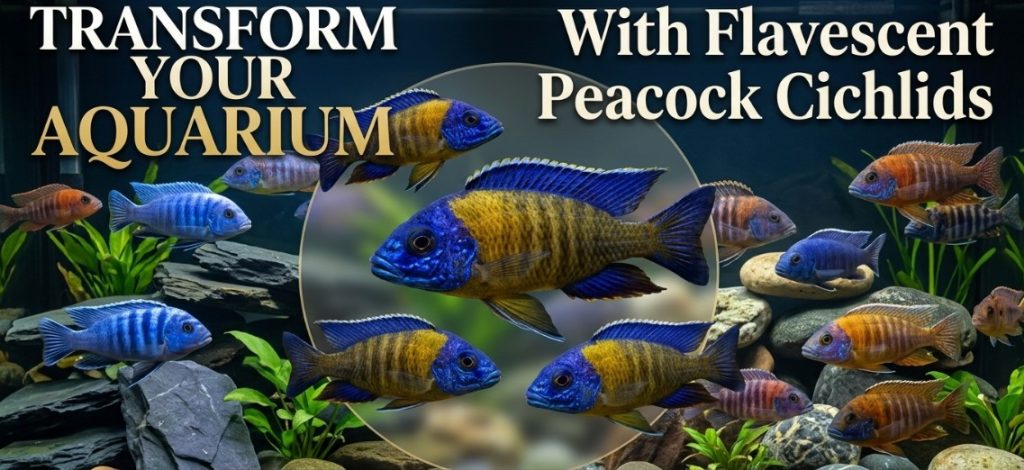
he Flavescent Peacock Cichlid is an amazing and multi-colored fish in a home aquarium. Its bright yellow and calm nature also characterizes it; therefore, aquarium hobbyists can make their aquariums colorful and lively.
Studies show that around 40 per cent of aquarium hobbyists do not maintain cichlid coloration and health in the first three months. Success depends on expert advice. This is why, to turn any tank into a most successful aquatic exhibit, you need to learn the special needs of Flavescent Peacock Cichlids.
This article offers care, tank, feeding, behavior, and breeding advice you need to keep your Flavescent Peacock Cichlids in good health.
What is a Flavescent Peacock Cichlid?
The Flavescent Peacock Cichlid is a yellow form of the native Aulonocara stuartgranti native to Lake Malawi in East Africa. Most guides only discuss its coloring and size, yet few can explain how sensitive it is to the conditions of the microhabitat.
They are found in the wild in rocky environments with either sandy or rocky bottom and mostly feed on benthic invertebrates.
Tip Box: To improve coloration, reduce stress, and stimulate natural behaviors in your tank, recreate these microhabitats.
How to Identify Male and Female Flavescent Peacocks
These cichlids are sensitive to sexing, which is necessary in breeding and harmonious co-existence in the tank.
- Males: Bright yellow with a faint blue streak on the fins. Greater size and strongly competitive behavior.
- Females: Grayish or muted yellow. Social interactions are more reserved and smaller.
Rare Tip: When Female Flavescent Peacocks are carrying eggs, they show a slightly darker vent area, and they have slight colour flashes when courting. These can be detected early to increase the breeding success.
How Big Do Flavescent Peacock Cichlids Grow?
In most cases, adults increase by 4-5 inches, but the increase is due to the duplication of microhabitats. Fish kept in tanks mimicking Lake Malawi’s rocky and sandy zones often reach optimal size faster.
| Feature | Male | Female |
| Average Length | 5 in | 4 in |
| Color | Vibrant yellow with blue accents | Muted gray-yellow |
| Lifespan | 7–10 years | 7–10 years |
To promote healthy growth and natural behaviours, adequate hiding areas and water-consistent environments are essential, which are usually absent in traditional aquarium systems.
Also Read: Peacock Cichlid Fish Guide for Beginners and Enthusiasts
What Do Flavescent Peacock Cichlids Eat?
A variety of diets is a concern of color vibrancy and longevity.
- High-quality spirulina cichlid pellets.
- Frozen or live food like brine shrimp and bloodworms.
- The vegetable content is occasionally present and includes blanched spinach.
Flavescent Peacocks also feed on sandy substrates instead of open water. The ability to sift through fine sand resembles natural hunting behavior, and it lowers stress.
| Food Type | Frequency | Purpose |
| Cichlid pellets | Daily | Balanced nutrition |
| Live/Frozen invertebrates | 3x/week | Color enhancement & protein |
| Vegetables | 1x/week | Digestive aid & fiber |
Tip Box: Rotate diet weekly for best coloration and health.

How to Set Up a Tank for Flavescent Peacock Cichlids
The last consideration that hobbyists overlook is properly setting up the tank.
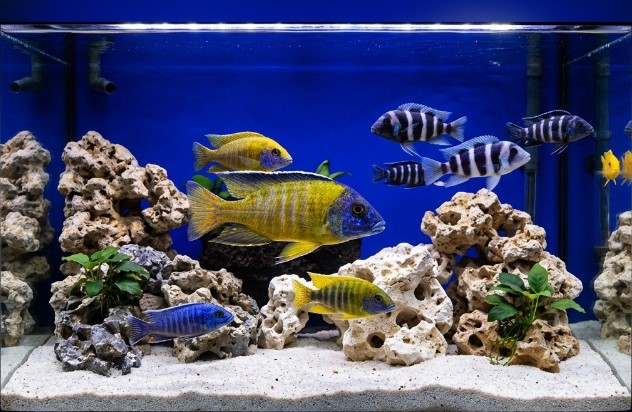
- Tank Size: at least 55 gallons, 1 male and 3-4 females.
- Substrate: Territories-flat rocks and fine sand.
- Water Conditions: PH 7.8-8.6, temperature 76-82degF.
- Lighting: Soft LED lighting enhances natural yellow colors.
- Decor: Sparse rock structures to mimic Lake Malawi biotopes.
Overcrowding increases aggression and dulls colors. This natural social hierarchy and courtship are facilitated by the development of micro-territories containing rock caves and sand plains.
What is the Behavior and Temperament of Flavescent Peacocks?
Flavescent Peacocks are peaceful but also territorial and have slight social standings that are hardly documented in standard guides.
- Males defend small territories around rock formations
- Females display cautious interactions near dominant males
- Courtship involves lateral flaring, color flashing, and sand-sifting
Observing sand-sifting behavior indicates reduced stress. Sand-free tanks can lead to such maladaptive behaviors as fin-nipping or hiding.
Which Tank Mates Are Best for Aulonocara stuartgranti?
Flavescent Peacocks live with other peaceful or semi-aggressive species. Incompatible tank mates can cause stress and color fading.
Recommended tank mates:
- Other Aulonocara variants: Blue Neon, Maleri, Cobue
- Larger Haplochromis species
- Certain peaceful African cichlids
Avoid: Territorial aggressive Mbuna cichlids.
Tip Box: Introducing tank mates should be done one at a time to reduce stress and promote natural social behavior.
How to Maintain Health and Prevent Diseases
Prevention and early detection are important:
- Maintain the water parameters: ammonia = 0, nitrite = 0, nitrate
- Partial change of water weekly (~ 20-25 %).
- Do not use sudden temperature changes.
- Observe fish to determine distress, hiding, color loss, and loss of appetite.
Common issues:
- Ich (white spot disease): Treat early with increased temperature & safe medication
- Fin rot: This is attributed to bacterial infections occasioned by low-quality water.
- Loss of coloration due to stress: This is normally due to overcrowding or incompatible tank mates.
How to Enhance Coloration in Flavescent Peacock Cichlids
Color vibrancy is influenced by diet, environment, and stress reduction.
- Diet: Pellets of spirulina and high-protein living/frozen foods.
- Lighting: Soft LED or full-spectrum lighting.
- Tank design: Fine sand + flat rocks for territories
- Water stability: Maintain consistent pH & temperature
Flavescent Peacocks may display temporary “flash colors” during courtship, a sign of proper environmental enrichment.
How to Breed Flavescent Peacock Cichlids
Flavescent Peacocks are the mouthbrooders. Breeding requires patience and observation.
| Stage | Duration | Key Actions |
| Courtship | 1–3 days | Male displays color & flares fins |
| Egg Transfer | 1 day | A female collects eggs in her mouth |
| Mouthbrooding | 21–28 days | Minimize stress, avoid tank mate interference |
| Fry Release | 1 day | Ensure a soft substrate for fry survival |
| Fry Growth | 2–3 months | Offer microfoods such as baby brine shrimp |
The females carrying eggs can also exhibit minor alterations in color intensity, a darker vent area, and less activity.
Real‑World Case Study: Lake Malawi Insights
Lake Malawi: Biodiversity-Hotspot
- Approximately 700+ species of cichlids, of which 1,000 have not been described (Wikipedia)
- Highly prized for coloration, feeding, and breeding behavior
Freshwater Hobby Trends:
- ~90% of ornamental fish are freshwater
- 13% of U.S. households maintain aquariums
- 70% of beginners quit within the first year (WifiTalents)
Takeaways for Hobbyists:
- Recreate natural microhabitats
- Follow evidence-based care for water, diet, and tank mates
- Encourage ecological enrichment through sand-sifting and by display of territory.
Expert Tips and Troubleshooting
- Crowding dilutes color and creates stress.
- Rotate diet for protein and vegetable balance
- Monitor water parameters weekly
- Observe sand-sifting behavior as an indicator of health
Conclusion
The Flavescent Peacock Cichlid is the ideal fish for a home aquarium owner looking for bright, peaceful, and pretty fish. Knowing the Aulonocara stuartgranti care, tank mates, and color considerations to hobbyists allows them to create successful aquascapes. Proper management of diet, habitat, and water makes plain tanks bright underwater environments.
To get professional guidance, tank configurations, and quality Flavescent Peacock Cichlid, visit Peacock Cichlid Zone.
FAQs
Are Flavescent Peacocks and Aulonocara stuartgranti the same fish?
The yellow color variant of Flavescent Peacock is known as Aulonocara stuartgranti.
What is the difference between a Flavescent Peacock and a Blue Neon?
Flavescent Peacocks are yellow, and Blue Neon cichlids glisten with iridescent blue stripes.
How big do Flavescent Peacock cichlids get?
Mostly, this will be the best-case scenario in adulthood, 4-5 inches.
Why is my female Flavescent Peacock gray instead of yellow?
The females naturally exhibit dull coloration, and their colours fluctuate with food, water quality, and breeding seasons.
What are the best tank mates for Aulonocara stuartgranti?
Other Aulonocara morphs, peaceful cichlids, and larger Haplochromis species.
How do I get my Flavescent Peacock to show its best colors?
Ensure appropriate water environments, a balanced diet, low levels of stress, and proper lighting.
Can Flavescent Peacocks live with Mbuna cichlids?
Not recommended, because aggressive Mbuna are territorial invaders and stressed.
What is the ideal pH and temperature for Aulonocara stuartgranti?
Optimal pH is 7.8–8.6, and temperature is 76–82°F.
How can I tell if my Flavescent Peacock is holding eggs?
When mouthbrooding, females display a darker vent and a rounded belly.
Are Albino Flavescent Peacocks more aggressive than the standard variety?
No, aggression is more dependent on temperament and the tank conditions.
References:
Froese, R. & Pauly, D. (Eds.). (2025). Aulonocara stuartgranti Meyer & Riehl, 1985, Flavescent Peacock. FishBase. World Wide Web electronic publication.
https://www.fishbase.se/summary/Aulonocara-stuartgranti
Wikipedia contributors. (2025). Lake Malawi. Wikipedia, The Free Encyclopedia.
https://en.wikipedia.org/wiki/Lake_Malawi
Salzburger, W., Van Bocxlaer, B., & Cohen, A. S. (2014). Ecology and Evolution of the African Great Lakes and Their Faunas. Annual Review of Ecology, Evolution, and Systematics, 45, 519–545. DOI:
https://doi.org/10.1146/annurev-ecolsys-120213-091804
Livengood, E. J., & Chapman, F. A. (2007). The Ornamental Fish Trade: An Introduction with Perspectives for Responsible Aquarium Fish Ownership. University of Florida IFAS Extension. Publication FA124.
https://ask.ifas.ufl.edu/publication/FA124