


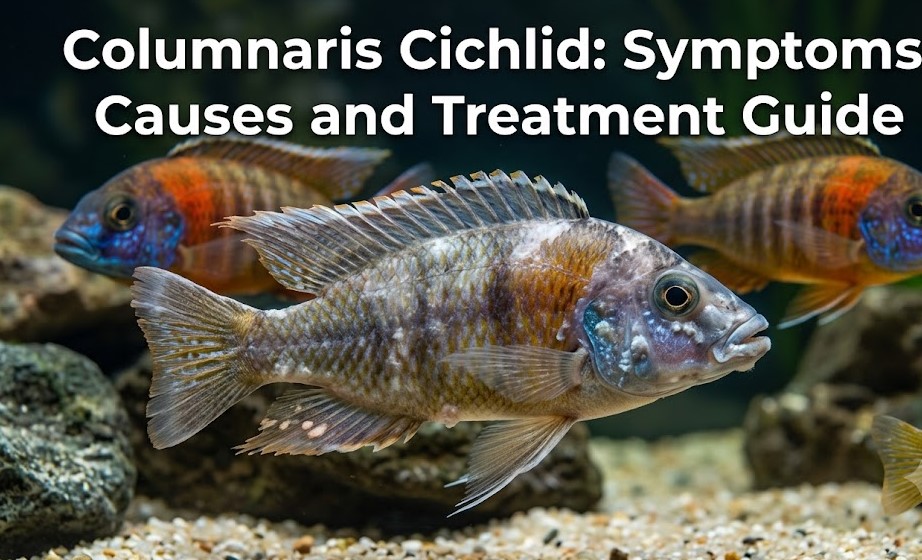
Columnaris cichlid infections cause some of the fastest fish losses seen in home aquariums, and fisheries researchers rank the disease among the top bacterial killers in freshwater fish.
According to the American Fisheries Society Fish Health Section, columnaris disease is a highly destructive bacterial infection that can cause mortality rates of 60% to 90% with 60% to 90% mortality being common during outbreaks.
In pond-raised channel catfish, it is the second leading cause of disease-related death after enteric septicemia. Although these figures come from aquaculture studies rather than home aquariums, they highlight how aggressive Flavobacterium columnare can be.
That is why even a small white patch on a cichlid should be treated as a medical emergency instead of a condition to monitor and wait out.
The bacterium behind a columnaris cichlid outbreak, Flavobacterium columnare, already lives in most established tanks and stays harmless until a fish is injured, stressed, or kept outside its comfort range.
SRAC publication on columnaris disease confirms that Flavobacterium columnare is highly active between 25°C and 32°C (77°F to 90°F), which directly overlaps with optimal cichlid tank temperatures.
This guide covers identification through recovery using the terms aquarists search most, including cotton wool disease, columnaris disease in fish, and cichlid columnaris treatment.
What Is Columnaris in Cichlids?
Columnaris in cichlids is a bacterial skin and gill infection, not a fungus, caused by the gram-negative bacterium Flavobacterium columnare.
Fisheries literature describes it as an opportunistic pathogen that typically needs a trigger, such as a wound, ammonia exposure, or temperature stress, before it becomes a full infection.
Once established, the bacteria attach to the mucus layer and gill filaments and spread across tissue faster than most other bacterial fish pathogens.
A columnaris cichlid case can move from a faint mark near the mouth to widespread body involvement in two to three days under warm conditions. Controlled studies on anadromous salmonids show columnaris mortality climbing from 4–20% at 12.2°C (54°F) to as high as 100% at 20.5°C (69°F) confirming a direct link between warmer water and faster disease progression.
Cichlid tanks run well above that lower figure, which is part of why cichlid columnaris treatment needs to start the moment symptoms appear.
Is Columnaris the Same as Cichlid Cotton Wool Disease?
Yes, cichlid cotton wool disease and columnaris describe the same bacterial infection under different common names used across forums and fish stores.
| Common Name | What It Refers To |
| Columnaris | Clinical name for the disease |
| Cotton wool disease | Named after the cottony, thread-like lesions |
| Cotton mouth disease | Used when lesions concentrate near the mouth |
| Saddleback disease | Used when the lesion bands across the back |
Cotton wool disease in fish always traces back to Flavobacterium columnare regardless of the name used, so treatment does not change based on terminology.
Symptoms of Columnaris in Cichlids
The symptoms of columnaris follow a recognizable pattern, and pathology reports note that visible lesions can double in size within 24 to 48 hours of appearing.
Early Signs
- Thin white or grey film near the mouth, gill covers, or fin edges, often mistaken for slime coat
- Small frayed patches at the fin tips rather than the base
- Fish flashing, or scraping its body against gravel and decorations
- A drop in appetite before any lesion becomes visible
Advanced Signs
- Cottony, thread-like growths spreading across the skin
- Yellow-tinted ulcers, a color caused by dense bacterial colonies at the site
- Gill tissue that looks pale, corroded, or frayed at the edges
- Rapid gill movement or gasping at the surface from oxygen stress
Gill involvement is the stage most closely linked to fatality; experimental infection studies on grass carp recorded gill damage in more than half of the fish tested.
Columnaris vs Fungal Infection
Columnaris is routinely mistaken for a fungal infection, and pathology guides list this as one of the most common misdiagnoses among home aquarists.
| Feature | Columnaris | Fungal Infection |
| Cause | Flavobacterium columnare (bacterium) | Saprolegnia or related water molds |
| Spread pattern | Migrates across skin, fins, gills within days | Stays localized near the wound |
| Structure | Flat, slimy bacterial mat | Raised, fluffy fungal tufts |
| Typical location | Mouth, gill covers, fin margins | Open wounds, dead tissue |
| Response to antibiotics | Improves within days | No improvement |
What Causes Columnaris in Cichlid Tanks
Columnaris disease in fish tanks is rarely random, since the bacterium already lives in most aquarium water. An outbreak signals that stressors have weakened the fish’s mucus barrier and immune defenses.
Water Quality
Ammonia and nitrite spikes damage the tissue that blocks bacterial entry, and research lists poor water chemistry as a primary outbreak trigger.
Temperature Stress
Catfish aquaculture studies confirm that Flavobacterium columnare thrives in warmer water, exhibiting rapid reproduction and peak virulence between 25°C and 32°C (77°F to 90°F). Because most home cichlid aquariums are standardly maintained between 24°C and 28°C (75°F to 82°F), these popular ornamental tanks inherently sit within the high-risk zone for a severe outbreak.
Tank Aggression
Crowding raises physical contact and oxygen competition, and farmed-fish research shows mortality begins earlier in dense populations. African cichlid columnaris cases are especially common in territorial tanks, where nipping creates entry wounds.
New Fish Introduction
Adding fish without quarantine is one of the most common ways infection enters a tank, since carriers can look healthy while shedding bacteria. A two to three week quarantine window is standard practice for catching this early.
Is Columnaris Contagious?
Columnaris is highly contagious and transmits horizontally, passing directly from fish to fish through shared water rather than needing a vector. A single infected cichlid can expose every tank mate within hours of the first lesion, so a fish disease columnaris outbreak in a mixed community should be treated as an emergency.
Moving the affected fish to quarantine as soon as symptoms appear remains the most effective way to protect the rest of the tank.
How to Treat Columnaris in Cichlids
Cichlid columnaris treatment works best as a layered approach that combines environmental correction with targeted medication.
Water Changes
Performing a 30% to 50% water change every one to two days during treatment physically removes free-floating bacteria. This aggressive schedule also dilutes toxic ammonia byproducts, preventing the severe gill irritation and immune suppression that fundamentally fuel the progression of the infection.
Aquarium Salt Method
The use of aquarium salt as treatment for mild cases of fungal cichlid disease is very effective. The salt disrupts the bacterium’s membrane and eases osmotic stress on the skin. A common salt level is 1 to 3 tablespoons of salt in 5 gallons of water. This treatment is done over a period of time.
It is also important to note that this treatment is adjunct and will not cure columnaris disease. It is important to note that aquarium salt treatment should not be relied upon as the primary treatment.
Medications and Antibiotics
For more advanced diseases the treatment of choice for columnaris in fish is antibiotics such as kanamycin or nitrofurazone. Typically a combination therapy is used, as two-drug treatments are generally preferred.
A standard treatment period is 5 to 7 days, with a second treatment period being required to clear lesions after the first treatment. It is important to read the label for any columnaris treatment in fish as the treatment will be specific for the concentration of the desired treatment.
How Long Does Columnaris Treatment Take in Cichlids?
How fast an infection resolves is based mostly on how early it is caught, and early cases of cotton wool disease resolve in under a week, while severe cases resolve in about three weeks.
Skin lesions begin to heal within three to five days of starting the antibiotic treatment, but cases involving gills take significantly longer, due to slower regeneration of gill tissues, and require a full two to three weeks. Treatment often fails because people stop the antibiotics after seeing an improvement.
Can Cichlids Recover from Columnaris?
Cichlids have a good chance of a complete recovery from columnaris if treatment is started in the early stage when it is just a skin infection. However, if columnaris has progressed to the gills, the chances of recovery decrease significantly.
In the absence of treatment, mortality is reported as high as 90% based on community fishery statistics, and the chances of recovery are much better if treatment is attempted rather than waiting and observing. Tissue regeneration for fins and skin occurs in a matter of weeks, and most cichlids that were infected and showing a good response in treatment in that period recover completely.
Preventing Columnaris in Cichlid Tanks
To effectively prevent columnaris, the goal is to take away the stressors that allow the bacteria to become an infection. Since Flavobacterium columnare cannot be completely eliminated from the water, the prevention method is to focus on the stressors.
- Perform weekly water tests. Use a liquid kit at an interval of 0 ppm for both ammonia and nitrites.
- Adjust the stocking density to tank size. This consideration is especially important with territorial species such as African cichlids as well as those that are columnaris-prone.
- New fish must be quarantined for a period of 2-3 weeks.
- Do not allow the water temperature to rest over the cichlid range maximum for extended periods.
- Before transferring any nets, siphons, or decorations to other tanks, disinfect them.
Also Read : 18 Peacock Cichlid Disease: Symptoms, Causes, and Treatment Guide
Columnaris vs Fin Rot in Cichlids
Columnaris and fin rot both damage fins, but they differ in cause, speed, and how far the infection spreads beyond the fin.
| Feature | Columnaris | Fin Rot |
| Cause | Flavobacterium columnare | Various opportunistic bacteria |
| Speed | Body-wide within 48-72 hours | Gradual, fin-edge only |
| Appearance | White cottony film, possible ulcers | Ragged, blackened margins |
| Body involvement | Common, including gills | Rare, stays on fins |
Conclusion
When columnaris cichlid infections remain early-stage and limited to the skin, they are treatable using clean water, salt, and the right antibiotics. Because studies show that, in the majority of cases, the mortality rate of an untreated columnaris outbreak can be between 60–90%, fish keepers are recommended to act within the first 1–2 days rather than letting the deadline pass. T
he most practical long-term defenses are consistent water quality, a good stocking strategy, and appropriate quarantine practices.
FAQs
Is columnaris fatal in cichlids?
Yes, it is considered fatal, particularly once it spreads to the gills. Studies conducted in fisheries show that, in most cases, the mortality rate of an untreated columnaris outbreak can be between 60–90% of the affected fish.
How fast does columnaris spread in a cichlid tank?
An outbreak of the columnaris disease can infect every fish in a tank in an interval of between 24–72 hours. This is because the columnaris bacteria live in the water of the tank.
How do I know if it’s columnaris or a fungal infection?
Columnaris infections spread as a flat and slimy mat and occur at a rapid rate. In contrast, fungal infections grow in a localized manner as raised and fluffy tufts.
Can cichlids recover from columnaris?
Yes, as long as the disease has not spread to the gills or resulted in large, deep ulcers, cichlids can fully recover.
What is the best treatment for columnaris in cichlids?
The best treatment for columnaris includes a salt bath and a course of antibiotics (e.g. kanamycin, nitrofurazone) for 5–7 days, along with regular water changes.
Is aquarium salt effective against columnaris?
Treatment of cichlid cotton wool disease with aquarium salt is usually only effective if the columnaris outbreak is early and mild. If cichlid’s cotton wool disease has resulted in ulcers and gill damage, aquarium salt will be ineffective.
What are the common causes of Columnaris among cichlids?
Columnaris tends to develop because of overcrowding, injuries due to interspecies aggression, poor water quality, and warmer temperatures (above 23 degrees Celsius).
Is columnaris infectious? Will healthy cichlids eventually get columnaris from others in the same tank?
Yes, columnaris can be spread among cichlids due to horizontal transmission occurring in shared water and will likely infect a healthy cichlid in close contact with an infected tank cichlid.
How long does it usually take to treat columnaris?
Columnaris that are mild and only affect the skin tends to get better after 3 to 5 days. Cases that are more involved and/or that are affecting the gills typically take 2 to 3 weeks for treatment.
Will cichlids get columnaris after treatment?
Yes, columnaris has a high likelihood of recurrence after treatment if the cichlids are in a poor quality water environment again and/or if an antibiotic treatment is stopped prior to completing the course.
References:
Columnaris Disease in Fish: A Review with Emphasis on Bacterium-Host Interactions — PMC
https://pmc.ncbi.nlm.nih.gov/articles/PMC3648355/
Bacterial Diseases in Aquaculture — Merck Veterinary Manual
https://www.merckvetmanual.com/exotic-and-laboratory-animals/aquaculture/bacterial-diseases-in-aquaculture
Bacterial Diseases of Fish — Merck Veterinary Manual
https://www.merckvetmanual.com/exotic-and-laboratory-animals/aquarium-fish/bacterial-diseases-of-fish
Emerging Flavobacterial Infections in Fish: A Review — PMC
https://pmc.ncbi.nlm.nih.gov/articles/PMC4522593/
A Review of Molecular Responses of Catfish to Bacterial Diseases and Abiotic Stresses — PMC
https://pmc.ncbi.nlm.nih.gov/articles/PMC6119772