


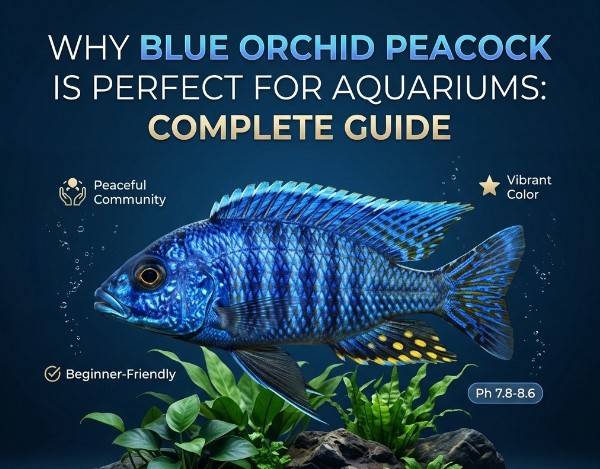
The general desires of aquarium hobbyists and owners of domestic aquariums include brightly colored, temperamentally predictable, and flexible species. Blue Orchid Peacock(Aulonocara kandeense) is one of the few cichlids that will fulfill all these requirements.
The American Pet Products Association reports that more than 12.5 million American households have freshwater aquariums, which indicates a successful ornamental fish market (source).
Besides being beautiful, the Blue Orchid Peacock possesses interesting behaviour, colouration, and breeding instincts, which are not normally covered in general texts.
What Is a Blue Orchid Peacock?
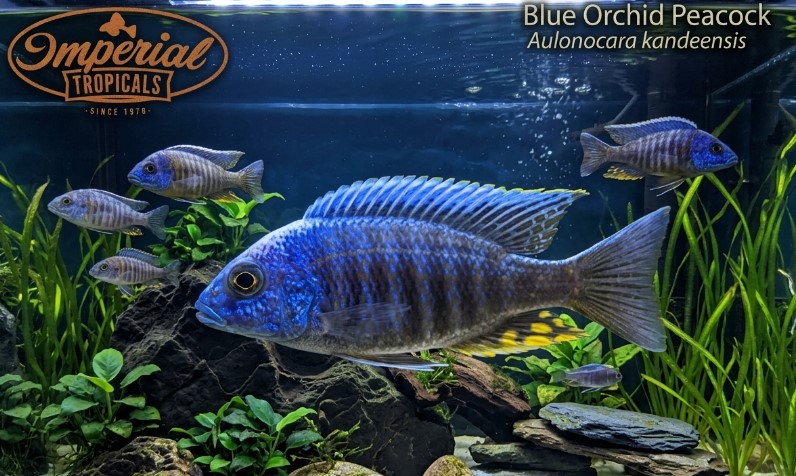
Blue orchid peacock is a freshwater cichlid that was initially found in Africa, also referred to as Aulonocara kandeense. This fish is described as electric blue with orange spots that can appeal to amateur or professional fishermen.
Alternate names include:
- Blue Orchid Fish
- Blue Orchid Cichlid
- Candy Peacock Fish
- Aulonocara kandeense kande
Unlike most African cichlids, the Blue Orchid Peacock is semi-aggressive, but allows itself to be introduced into community settings with other compatible tank mates. Its distinct foraging nature endears it to domestic aquariums.
What Makes Blue Orchid Peacock Different from Other Cichlids?
Blue Orchid Peacock is another cichlid that is distinguished by its behavior and coloring.
Behavioral Comparison:
| Species Type | Aggression | Behavior | Color Potential |
| Blue Orchid Peacock | Moderate | Semi-territorial | High, electric blue |
| Mbuna Cichlids | High | Aggressive & territorial | Bright but variable |
| Other Peacock Cichlids | Low-Moderate | Peaceful community | High |
The Blue Orchid Peacock is not particularly aggressive, unlike the Mbuna species, and is only territorial during breeding. It is a well-structured aquarium, as its foraging is quiet.
What Tank Setup Does a Blue Orchid Peacock Need?
Your Blue Orchid Peacock needs the best environment to ensure health, color, and peace.
Ideal Tank Size & Space Requirements
- The smallest tank size is 55 gallons, including one male and 2-3 females.
- The increased space will minimize stress and promote swimming activities and head-cutting competition.
Best Substrate (Sand vs Gravel)
- Sand acts like Lake Malawi, which encourages nature to sift.
- Gravel is okay, but it might be disrupting the feeding and killing the fin.
Decorations & Territory Design
- Include rock caves for hiding and breeding.
- Keep open swimming pools.
- Limit driftwood consumption to prevent conflicts.
Filtration & Oxygenation Strategy
- Good-quality canister or HOB filters to ensure good water quality.
- The moderate water flow replicates Lake Malawi currents using air stones or powerheads.
What Does a Blue Orchid Peacock Eat?
Blue Orchid Peacock is an omnivore that prefers high-protein foods.
Diet Breakdown:
- The sources of protein include cichlid pellets, brine shrimps, and daphnia.
- The foods that increase color are krill, quality frozen food, and Spirulina flakes.
- The diet plan consists of 2-3 small meals a day.
The periodic live or frozen foods imitate the natural foraging, making life more active and electrically colored.
Are Blue Orchid Peacocks Aggressive or Peaceful?
They are very peaceful and only exhibit territorialism, particularly during the breeding season.
- Territory relations: Caves and rock formations decrease disputes.
- Aggression control: Space, shelters, and similar tank-mates are determined to be compatible, which creates a balanced community.
They are semi-aggressive; therefore, they can be placed in mixed African cichlid tanks.

Which Fish Are Compatible Tank Mates?
Best companions:
- Peacock cichlids of other species ( Aulonocara species )
- Synodontis catfish (ground dweller)
- Peaceful Malawi species
Avoid:
- Aggressive Mbuna species
- Small, delicate fish prone to stress
| Tank Mate Type | Compatibility | Notes |
| Peacock cichlids | High | Similar temperament |
| Mbuna cichlids | Low | Aggressive & territorial |
| Synodontis catfish | High | Non-conflicting bottom dwellers |
| Tetras & small fish | Low | Potential stress & predation |
How Does Blue Orchid Peacock Breed in Aquariums?
Mouthbrooding Explained:
- Female incubates eggs for 21–28 days, protecting fry from predation.
Breeding Conditions:
- A little warmer (26-28 °C) stimulates the spawning.
- Give caves and flat rocks to the male displays.
Fry Care:
- Put fry in fry-safe tanks.
- Feed baby brine shrimp, and add pellets slowly.
How Long Does It Take to Full-Color Show?
- Juveniles: Light blue with slight undertones of orange.
- Males: Full electric blue matures at 8-12 months.
- Females: Keep tones low, although a nutritious diet will boost color.
Color improvement recommendations: Quality protein, water stability, stress, and LED light optimization.
Common Mistakes and How to Avoid Them
- Overstocking: Makes it aggressive, with less water quality.
- Wrong tank mates: Do not keep highly aggressive species.
- Poor water quality: Test frequently to eliminate disease and discolour.
- Overfeeding: Causes pollution and digestion problems.
Is Blue Orchid Peacock the Right Fish for You?
The Blue Orchid Peacock is a hobbyist favorite; it is a very colorful, semi-aggressive, and easy-to-handle peacock.
Best for:
- Beginners with large tanks
- The semi-aggressive cichlids of interest to intermediate hobbyists.
Not ideal for:
- Small tanks (
- Aggressive communities dominated by Mbunas
Expert Tips to Maximize Health and Color
- Lighting effects: LED spectrum increases blue tones.
- Diet hacks: Replace color-enhancing and protein foods.
- Stress relief: Hide places and avoid crowding, and keep the same water parameters.
Conclusion
Blue Orchid Peacock Cichlid is most suitable in a domestic aquarium because of its pretty coloration, easy care, and flexibility. Proper tank setting, diet, and care can maximize health, behavior, and bright colors.
The Blue Orchid Peacock will be the best choice if you wish to have a relaxing yet catchy centerpiece in your aquarium.
Explore your Blue Orchid Peacock options today at Peacock Cichlid Zone to bring Lake Malawi’s beauty into your home aquarium.
FAQs
What is the minimum tank size required for a Blue Orchid peacock?
The minimum tank size must be 55 gallons to provide some space and minimise aggression.
How do you distinguish between a male and a female Blue Orchid peacock?
Males are bright blue, whereas females are duller with grey or brown.
What are the ideal water parameters (pH, temperature, hardness) for this species?
Optimal conditions are pH 7.5-8.5, temperature 24-28 degC, and hardness 10-20 dGH.
Are Blue Orchid peacocks more aggressive or peaceful compared to other African cichlids?
They are fairly peaceful and non-aggressive, as most African cichlids, particularly Mbuna.
What is the best diet for a Blue Orchid peacock to maintain its color?
A protein-based diet with cichlid pellets, brine shrimp, and spirulina is required to sustain bright colors.
Which fish species make the best tank mates for a Blue Orchid peacock?
Other peacock cichlids, peaceful Malawi, and Synodontis catfish are also good tank mates.
How long does it take for a juvenile Blue Orchid peacock to develop its full adult colors?
Juveniles will achieve full adult coloration after 8-12 months with proper care.
What kind of tank setup and substrate (sand vs. gravel) do they prefer?
They like sandy foundations and rock caves, a free-swimming area, like their natural environment.
Are Blue Orchid peacocks maternal mouthbrooders, and how do they breed?
Yes, the females are maternal mouthbrooders; they keep their eggs 21-28 days after spawning.
References:
Froese, R. & Pauly, D. (Eds.) (2024). Aulonocara kandeense (Trewavas, 1935). FishBase. Retrieved from https://www.fishbase.se/summary/Aulonocara-kandeense.html
American Pet Products Association. (2023–2024). APPA National Pet Owners Survey. APPA. Retrieved from https://www.americanpetproducts.org/research/industry-trends-and-statistics
Konings, A. (2016). Malawi Cichlids in Their Natural Habitat (5th ed.). Cichlid Press. ISBN: 978-1932892093.
IUCN SSC Cichlid Specialist Group. (2024). Lake Malawi species habitat data.
https://www.iucncsg.org/
Keenleyside, M. H. A. (1991). Cichlid Fishes: Behaviour, ecology and evolution.
https://doi.org/10.1007/978-94-011-3720-1
FAO. (2023). Nutritional requirements and feeding of finfish for aquaculture. Food and Agriculture Organization of the United Nations.
https://www.fao.org/fishery/en/topic/13513