


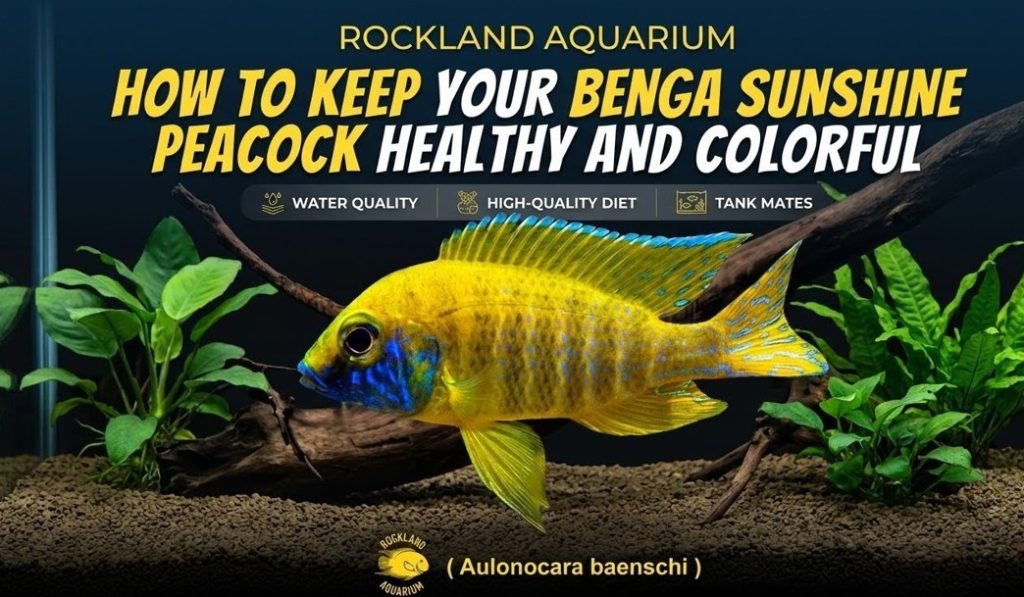
The Benga Sunshine Peacock is not only a stunning fish but also a color attraction in Lake Malawi, which requires professional care. Water quality, the diet, and the social environment require regulation to maintain the bright yellow and blue colors.
Studies on the welfare of ornamental fish indicate that transport, handling, and stress in early aquarium environments can cause death rates up to 73%, delaying the survival of fish such as Benga Sunshine Peacock.
This manual will cover advanced techniques of tank setup, nutrition, stress prevention, and breeding secrets.
What is Benga Sun Shine Peacock Cichlid
The Benga Sunshine Peacock Cichlid is a colorful freshwater fish from the Aulonocara genus, native to Lake Malawi in East Africa, admired for its bright yellow body and shimmering blue highlights. It is highly prized by aquarium hobbyists for its striking yellow body with iridescent blue accents, making it one of the most visually appealing African cichlids.
Major Characteristics of Benga Sunshine Peacock Cichlid
Benga Sunshine Peacocks reach 4-6 inches (10-15 cm). Males are larger and brightly colored; females are smaller and dull.
Tips for Healthy Growth:
- Feed pellets that are high in nutrition to cichlids
- Keep water hard and pH constant
- Notice social levels to decrease stress
Read more: Peacock Cichlid Fish Guide for Beginners and Enthusiasts
Minimum Tank Size for a Sunshine Peacock
The minimum number of gallons required for one male using females is 55 gallons, and the minimum difficulty community tank is 75 gallons.
Tank Setup Tips:
- Use a fine sand substrate for natural foraging
- Include rock caves and ledges for territorial males
- Give moderate light to improve yellow and blue pigments
- Provide high filtration to control bioload without altering pH or hardness
How to Tell the Difference Between Male and Female?
Males are bright yellow, with a splash of blue; the females are silver-grey and smaller.
Key Differences:
- Males: Large, bright yellow and blue, with a large dorsal fin.
- Females (benga peacock female): Soft silver or gray, smaller fins
Behavior also helps early sexing. Males excavate holes, flaunt fan-fins, and are more dominant, whereas the female sex is more withdrawn. Recognizing these patterns prevents injuries in mixed tanks.
Best Tank Mates for Benga Sunshine Peacocks
Peaceful peacock cichlids (Aulonocara species), bottom dwellers (e.g., Synodontis catfish or Plecos). Aggressive Mbunas or highly territorial Haps are to be avoided.
Recommended Tank Mates:
- Other peacock cichlids (Aulonacera species)
- Examples of haplochromis include the Red Empress
- Bottom dwellers: Synodontis or Plecos
Avoid:
- Mbuna cichlids (show too much aggression)
- Extremely territorial Haps (e.g., Nimbochromis)
- Slow, small, easily bullied fish
Read more: 200 Peacock Cichlids List: Species, Types, Names, and Color Variants
Ideal Water Parameters
The Benga Sunshine Peacocks are cultivated in slightly alkaline water with a pH of 7.8-8.6 and 24-28 °C (75-82°F).
Hobbyists with experience maintain GH 10-20 dGH, KH 8-12 dKH to recreate Lake Malawi. Soft water or sudden shifts in pH may reduce immunity and color stability.
Water Monitoring Checklist:
| Parameter | Recommendation |
| pH | 7.8–8.6 |
| Temperature | 24–28°C |
| GH | 10–20 dGH |
| KH | 8–12 dKH |
| Observations | Watch for clamped fins or dull colors |
Best Diet to Enhance Yellow Color
Feed good-quality carotenoid-fortified cichlid pellets, live or frozen food.
- Rotate diet after a week to attain nutritional balance
- Incorporate vegetable flakes to facilitate digestion
- Eat little, twice a day, do not overfeed
- You sometimes incorporate natural carotenoids or color-enhancing supplements.
Breeding Behavior & Fry Care
Benga Sunshine Peacocks are maternal mouthbrooders; the female bears the eggs and the fry.
Tips for Breeding Success:
- Offer flat stones or sandy grounds to spawn
- Isolate the Bengal peacock female and brood her in a breeding tank
- Juveniles develop well by being fed low-protein, small flakes or baby brine shrimp
Preventing Stress & Common Diseases
Stress shortens life and fades out colors.
Prevention Tips:
- Maintain stable water parameters
- Quarantine new fish 2–4 weeks
- Avoid overcrowding
- Record first symptoms of disease: feeling of weakness, clamped fins, spots
Common Diseases:
- Malawi Bloat: Dietary deficiencies or acute water change
- Parasites: Introduction: Through live food
- fin Rot: Stress or water of poor quality
Prevention Checklist:
- Quarantine new fish
- Regular water testing & partial changes
- Balanced diet with minerals
- Adequate hiding spaces
Advanced Tips Most Hobbyists Overlook
- Provide fine sand substrate for natural sand-sifting and digestion
- Rotate protein, carotenoid, and plant-based foods for color enhancement
- Observe social hierarchy to prevent subordinates from stress
- Moderate LED lighting enhances yellow benga sunshine peacock hues without overstressing fish
Real-World Case Study
A California hobbyist noted the dull colors in a 75-gallon tank of Benga Sunshine Peacock.
- Water hardness: 12 dGH
- pH: 8.0
- Diet rotation of high-carotenoids
- Added rock caves and hiding spots
In 4 weeks, the male recovered lively yellow coloration, and the territorial dispute reduced.
Conclusion
To maintain your Benga Sunshine Peacock in better health and colour, you need to look into natural habitats, recreation, water quality, food, and social control. These tank arrangements, feeding schedules, and feeding plans will help you keep your fish alive and with beautiful yellow and blue colors.
Begin practicing these care tips and see your sunshine peacock fish thrive. Visit the Peacock Cichlid Zone to get resources, information, and knowledge.
FAQs:
How big do Benga Sunshine Peacocks get?
Males are larger and more colorful (approximately 4-6 inches (10-15 cm).
What is the minimum tank size for a Sunshine Peacock?
55 gallons per male, together with females; 75 or more gallons per community establishment.
How can I tell the difference between a male and a female?
Males are bright yellow and blue with a larger fin, and females are silver-gray with a smaller fin.
What are the best tank mates for this species?
Haplochromis are non-aggressive peacocks that dwell at the bottom.
Why is my Sunshine Peacock losing its color?
The causes are stress, improper diet, water quality, and interpersonal conflicts.
What is the ideal pH and temperature for their water?
The ideal pH is 7.8–8.6, and the temperature is 24–28°C (75–82°F).
Are Benga Sunshine Peacocks aggressive?
Males and females are semi-aggressive, mostly territorial.
What is the best diet to enhance their yellow color?
High-quality pellets, live/frozen, carotenoid-added flakes; alternate diet every week.
Can they be kept with Mbuna cichlids?
No, Mbunas are too violent to sunshine peacock benga yellow fish.
References:
IUCN Red List, Aulonocara baenschi Conservation Status
https://www.iucnredlist.org/species/61061/47231572
Aulonocara baenschi, Species Summary
https://www.fishbase.se/summary/SpeciesSummary.php?genusname=Aulonocara&speciesname=baenschi
Journal of Experimental Biology (The Company of Biologists)
Diversity in Rest–Activity Patterns Among Lake Malawi Cichlid Fishes
https://journals.biologists.com/jeb/article/224/7/jeb242186/238727
Carotenoid Pigments in Seafoods and Aquaculture
https://pubmed.ncbi.nlm.nih.gov/9491309
New Mexico State University Extension (Aquaponics), Important Water Quality Parameters in Aquaponics Systems